Bringing History to Life with Timeline Games
History makes sense when students know what came before what. Five kinds of timeline question, a ready-to-use round with answers, and how to score a near miss fairly.
 By the Giga Quizzes team4 min read

In this post
Here is a question that surprises almost every class: did Cleopatra live closer in time to the building of the Great Pyramid, or to the first Moon landing? The answer is the Moon landing, by roughly five hundred years. The pyramid was already over two thousand years old when she was born. Questions like that are why timeline games work so well in history. They test whether students have a feel for the shape of the past, not just a list of dates, and they are some of the most enjoyable questions you can put in front of a class.
Why order matters more than dates
Dates on their own are easy to memorise and easy to forget. What gives them meaning is their relationship to each other: what came first, what was happening at the same time, and how much time lay between. Cause and effect only make sense in sequence. A student who knows that the printing press came before Columbus can see how news of his voyage spread across Europe; a student who knows only the two dates cannot.
Many students carry history around as separate boxes, “the Romans”, “the Egyptians”, “the Tudors”, with no sense of how they line up. Timeline questions put the boxes on one shelf.
Five kinds of timeline question
| Kind | Example | What it tests |
|---|---|---|
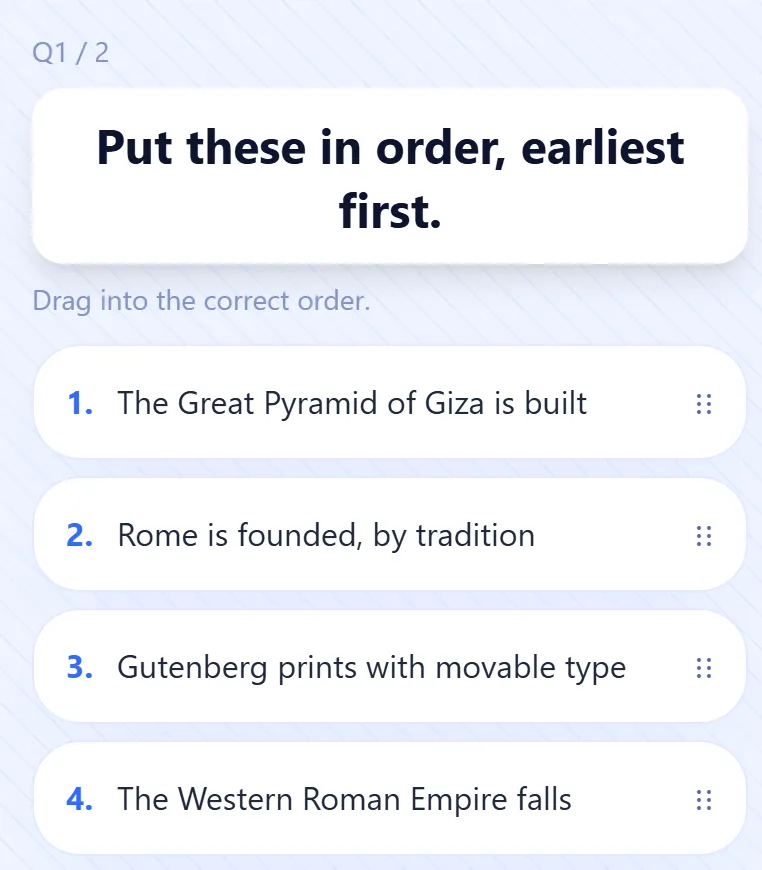
| Put in order | Earliest first: Battle of Hastings, Magna Carta, the Black Death reaches Europe, Columbus’s first voyage | Sequence across a whole period |
| Before or after | True or false: the printing press reached Europe before Columbus’s first voyage | Where two events sit against each other |
| Place the year | Drag the marker to the year the Berlin Wall fell | A sense of when, with credit for being close |
| Cause and effect | Match each cause to the event it led to | The links between events |
| Date the source | From which century is this painting? | Reading clues in a picture or document |
A good quiz mixes them. Ordering and before-or-after questions build the overall shape; place-the-year questions add precision; cause and effect turns a list into a story.
Choosing events that work
- Space them out. Two events a few years apart make an ordering question a coin toss. Pick events far enough apart that knowing the period is enough.
- Use anchor events. A few well-known moments, such as the fall of Rome, 1492 or the First World War, give students fixed points to hang everything else on.
- Avoid disputed dates. Where a date is legendary or approximate, say so in the wording: “Rome is founded, by tradition”.
- Four or five items is plenty. Eight is possible, but dragging that many on a phone takes time, so give long ordering questions 45 seconds or more.
Scoring the near miss
A student who puts the end of the Second World War in 1944 understands the period; one who says 1850 does not. A good timeline quiz should tell those two apart, and a right-or-wrong score cannot.
Giga Quizzes has three ways to give credit for being close. An Ordering question gives each item in its right place its share of the points, so swapping two neighbours still scores well. A Slider lets students drag a marker to a year, and with Close answer on, an answer near the right one earns points, fewer the further away it lands; Intensity sets how quickly they fall away. A Numeric question does the same for a typed year, with a tolerance such as five years either side.
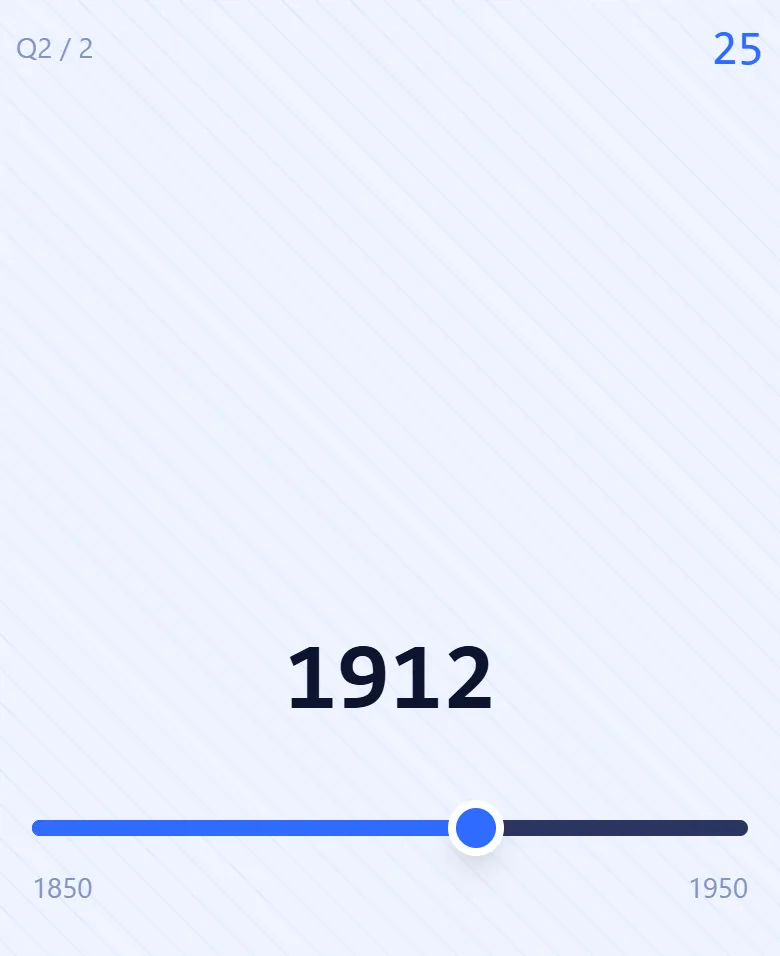
Set the range of a slider with care. From 1850 to 1950 gives a question about the First World War a sensible spread; from 0 to 2000 makes every answer look close on a phone screen, and the points stop meaning much.
A ready-to-use timeline round
Seven questions, with answers
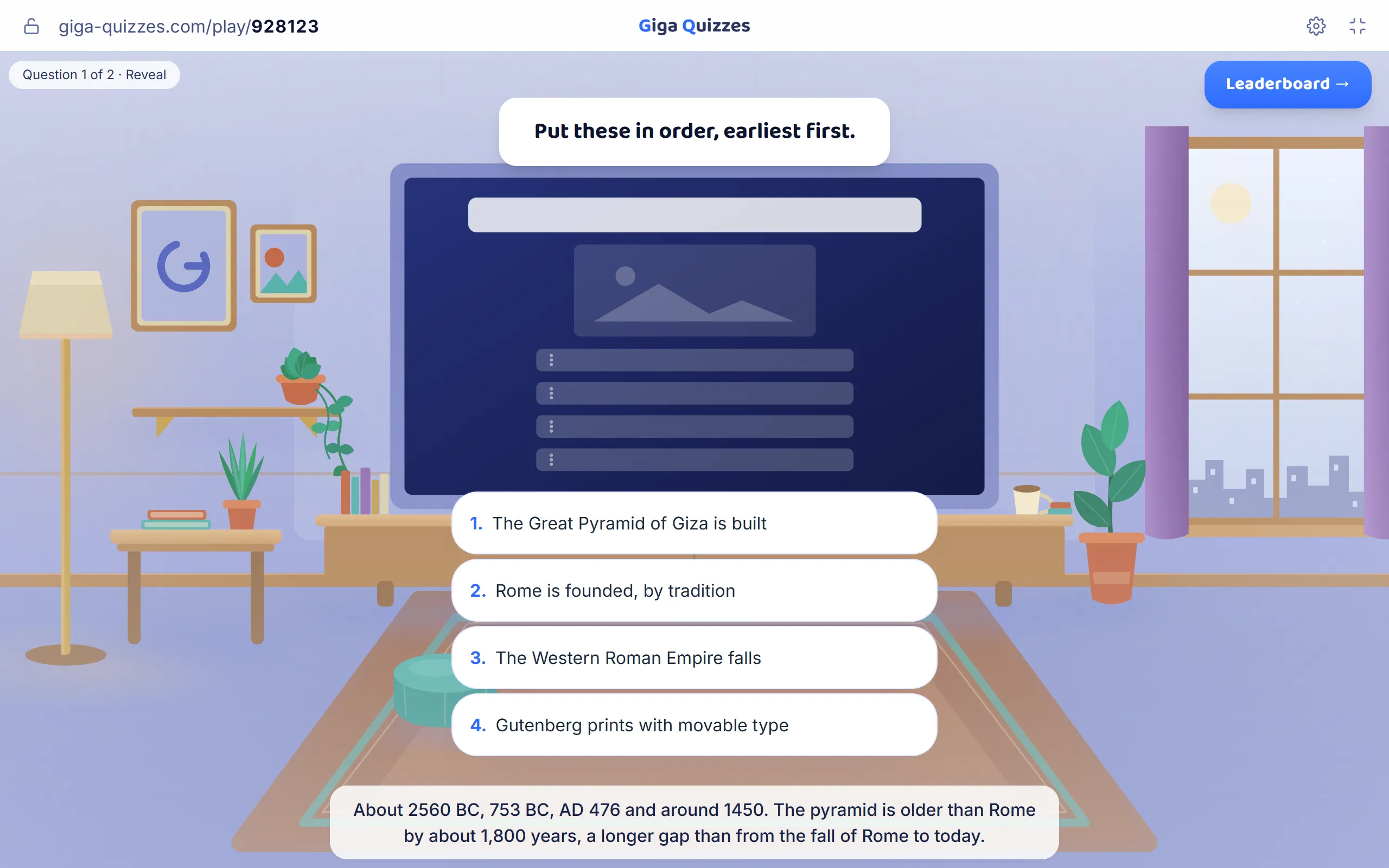
- Earliest first: the Great Pyramid of Giza, the founding of Rome by tradition, the fall of the Western Roman Empire, Gutenberg’s printing press. (About 2560 BC, 753 BC, AD 476, around 1450.)
- True or false: Cleopatra lived closer in time to the first Moon landing than to the building of the Great Pyramid. (True.)
- Drag to the year the First World War began. (1914.)
- Did the French Revolution begin before or after the American Declaration of Independence? (After: 1789, thirteen years later than 1776.)
- Earliest first: the first powered aeroplane flight, the first person in space, the first Moon landing, the fall of the Berlin Wall. (1903, 1961, 1969, 1989.)
- Drag to the year of the Battle of Hastings. (1066.)
- Which came first, Magna Carta or the Black Death in Europe? (Magna Carta, in 1215; the Black Death arrived in 1347.)
Question five makes a good discussion: only 66 years separate the first powered flight from people walking on the Moon. Ask the class what else had to happen in between.
Turn the reveal into a story
The most valuable part of a timeline question often comes after the answer. When the order is revealed, ask why the events happened in that sequence. Why did one make the next possible? A sentence in the Explanation box appears under the answer on the big screen and on every phone: “Columbus’s letter about his voyage was printed and sold across Europe within months, thanks to the printing press” turns two dates into a connection students remember.
A twenty-minute timeline lesson
- Hook (2 minutes): the Cleopatra question, cold. Let the class argue before the reveal.
- Build the shelf (8 minutes): three ordering questions across your period, discussing each reveal.
- Sharpen (5 minutes): two place-the-year questions on the key dates of the unit.
- Connect (5 minutes): a cause-and-effect matching question, then ask students to explain one link aloud.
Try it in Giga Quizzes
Free, in the browser, and nothing for your students to install. These guides show each step on the real screens.
New to Giga Quizzes?
Free live quizzes in the browser. Students join from any phone, with no app.
Make your first quiz →