Learning Vocabulary in Hacker Mode
New words stick when students meet them again and again, and have to recall them each time. How to build a vocabulary set that does that, in three stages, and play it as a race.
 By the Giga Quizzes team5 min read
In this post
Learning words in a new language comes down to meeting them again and again, and pulling them out of memory each time, until they stay. That is exactly what makes vocabulary practice dull: flashcards and lists work, but very few students keep at them for long. A game that keeps bringing the same words back, without feeling like a drill, solves the problem. This post explains what the research says about repetition, how to build a vocabulary set in three stages, and why Hacker mode is a good way to play it.
Meeting a word once is not enough
One encounter rarely makes a word stick. In a study by Stuart Webb, learners met new words in example sentences one, three, seven or ten times. Their knowledge of the words grew with every extra meeting, and even after ten it was not complete. Whatever the method, a new word needs to come round many times.
How it comes round matters as much as how often. Jeffrey Karpicke and Henry Roediger taught students forty Swahili words with their English meanings. Once a student had recalled a word correctly, some kept being tested on it and others only kept studying it. A week later, the students who had gone on being tested remembered about 80 per cent of the words; those who had only restudied remembered around a third. Being asked a word again, after you already know it, is not wasted time. It is what makes it last.
Why a race that repeats works
Hacker mode in Giga Quizzes is built on exactly that loop. Every student plays on their own phone at their own pace, nobody waits for the class, and when a student reaches the end of the set the questions start again from the top. A set of fifteen words played for twenty minutes means each student meets every word several times, and has to recall it every time.
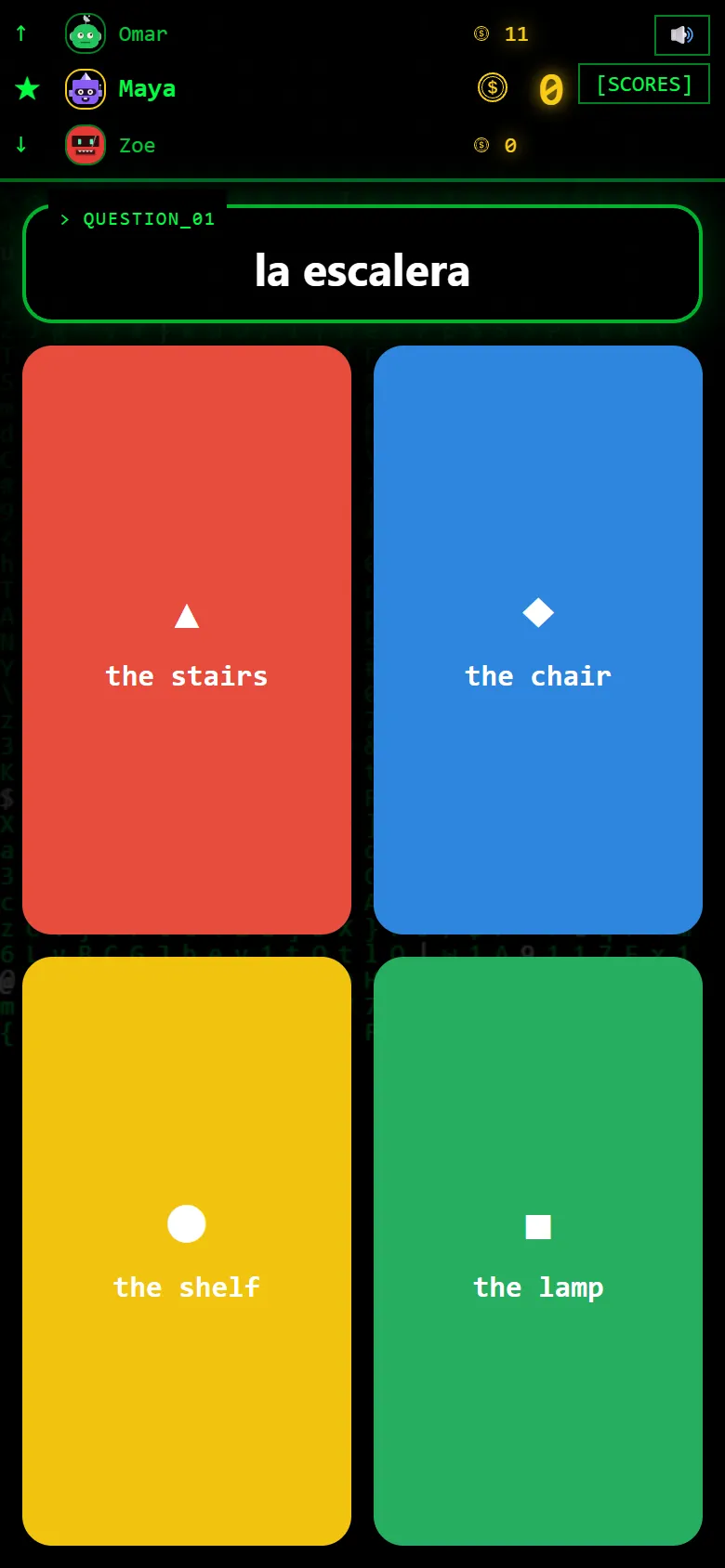
The game around the questions supplies the motivation. A right answer opens one of three vaults that pay crypto, multiply it, or let the student hack a classmate and take a share of theirs. A wrong answer locks the phone for a moment and shows the right answer, so random tapping is slower than thinking. Students learn within a round or two that it pays to stop and remember.
Stage 1: from the new language to their own
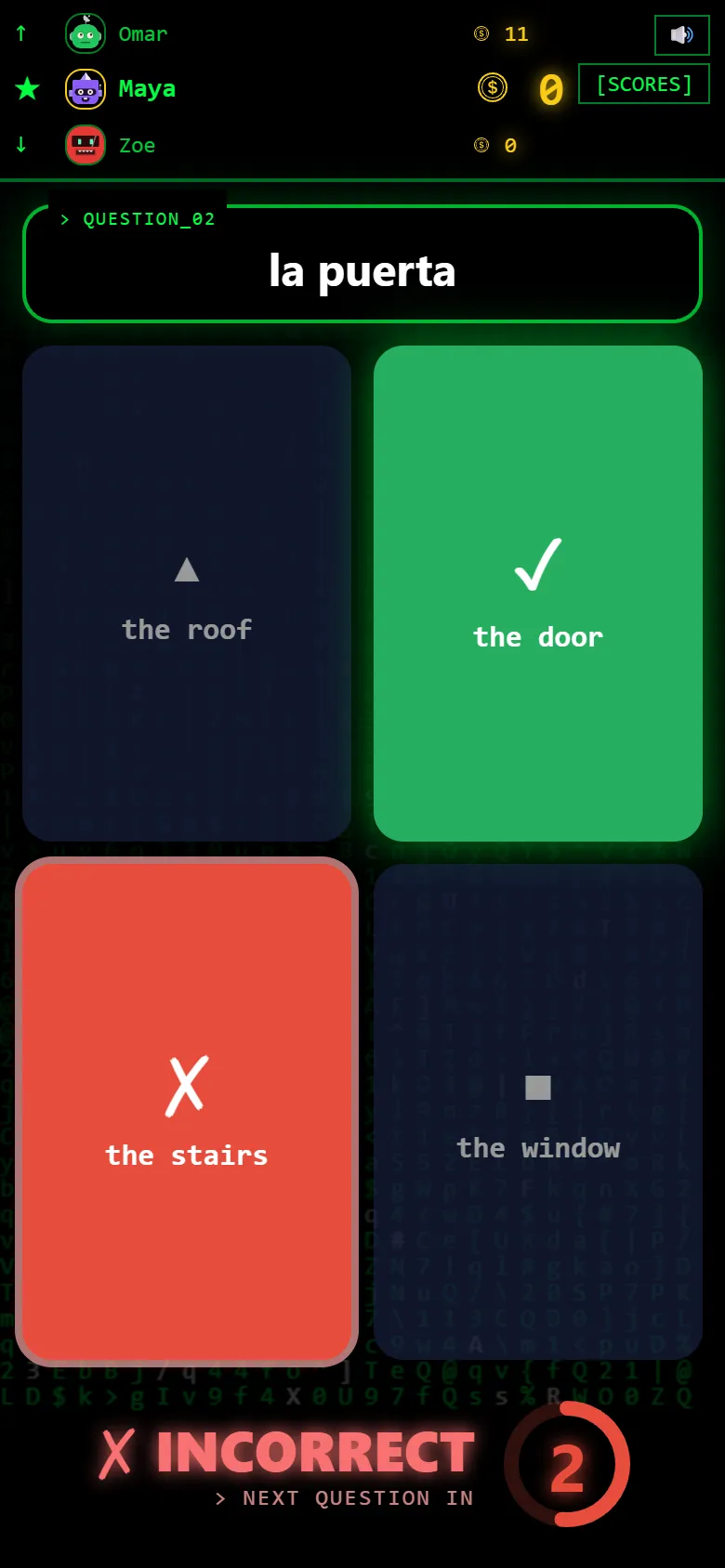
Start with recognition. Put the word in the language being learned as the question, and four answers in the students’ own language. Recognising a word and connecting it to its meaning is the first step in learning any word, and it is the easiest, which suits a brand new list.
The wrong answers do most of the work. Take them from the same topic, so a student has to know the word rather than guess the category. For a lesson on the house:
| Question | Right answer | Good wrong answers | Weak wrong answers |
|---|---|---|---|
| la ventana | the window | the door, the wall, the floor | the dog, red, to run |
| la cocina | the kitchen | the bedroom, the bathroom, the garden | the car, happy, the moon |
| el suelo | the floor | the ceiling, the wall, the table | the school, blue, to eat |
Ten to fifteen words is the right size for one set. With fewer, the questions repeat so often that the game becomes too easy; with more, each word comes round too rarely in one session to be learned.
Stage 2: turn it around
Once a class recognises the words, make a second set that goes the other way: the word in the students’ own language as the question, and four answers in the language being learned. Producing a word is harder than recognising it, so this set comes a few lessons after the first, when the words are starting to feel familiar.
The same rule about wrong answers applies, with a twist. Now the best distractors look or sound alike in the new language, such as la puerta, la pared and la planta, so students have to know the exact word and not just its first letter.
Stage 3: no options at all
The last step drops the options. An open answer question asks students to type the word themselves, which tests spelling as well as memory. List every form that should count, such as the word with and without its article, and add the spelling without accents too if you are happy to accept it. In a language class, where the exact spelling often matters, a case-sensitive answer only accepts the word exactly as written.
Typed answers take longer than taps, so give them more time, and expect the first round to feel hard. That difficulty is the point: recalling a word with nothing to prompt it is the strongest practice there is.
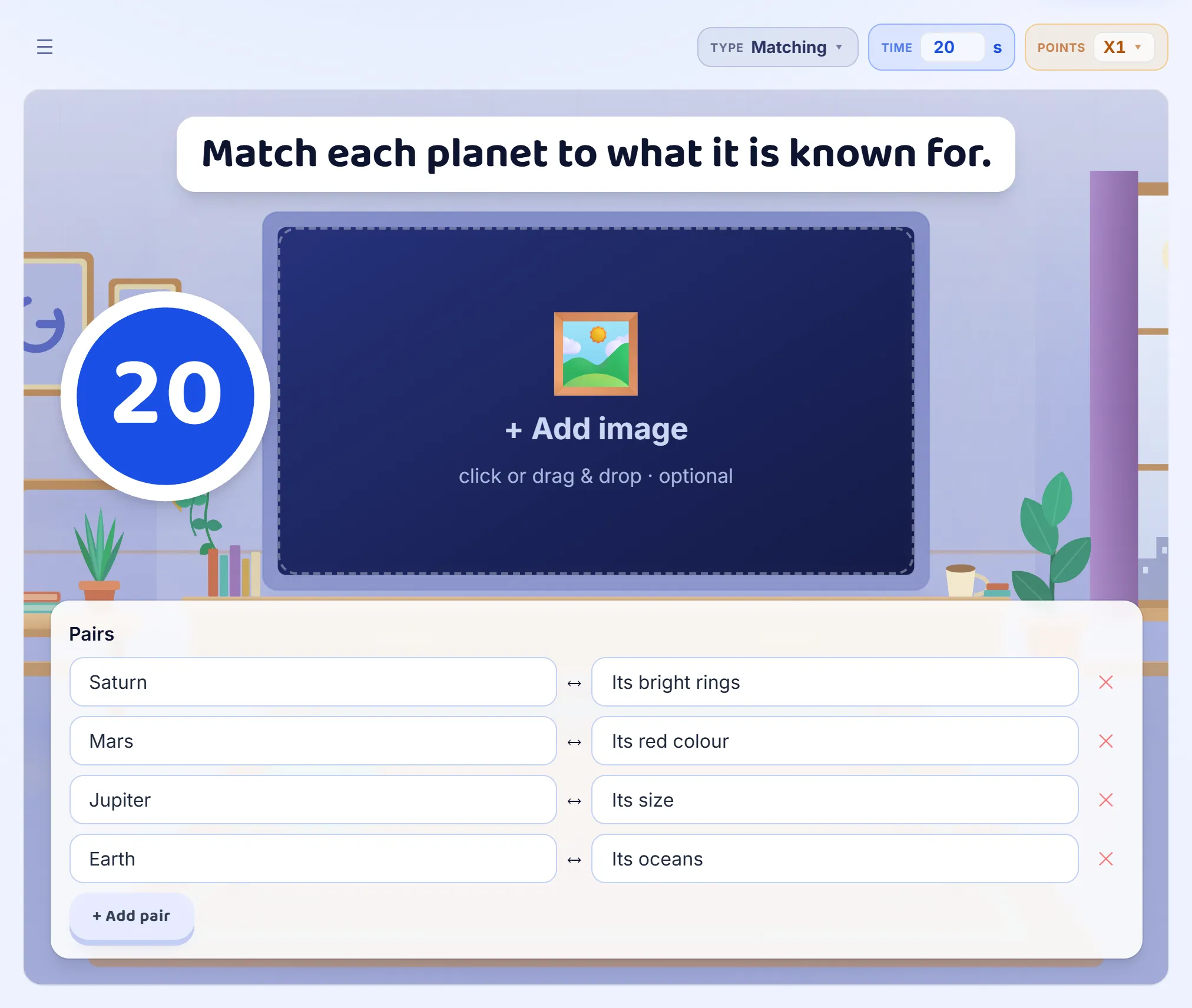
For a change of pace, a matching question gives students up to eight pairs to connect at once, which suits closed groups of words such as days, months, colours or opposites.
A week with one word list
| Day | Set | Minutes |
|---|---|---|
| Monday | Stage 1: new word in, meaning out | 10–15, at the start of the lesson |
| Wednesday | Stage 2: meaning in, new word out | 10 |
| Friday | Stage 3: typed answers, plus one matching question | 10–15 |
| Next Monday | The new list, with the three hardest words from last week added | 10–15 |
Carrying the hardest words into the next week’s list spaces them out, so they are recalled again after a gap, which is when practice does the most good.
How long to play, and what to read afterwards
In Game settings, choose Hacker and how the game should end. Timed stops it when the clock runs out, anywhere from one to sixty minutes; ten to twenty is right for vocabulary. Race to crypto ends the game when the first player reaches a target, which suits a short burst at the end of a lesson.
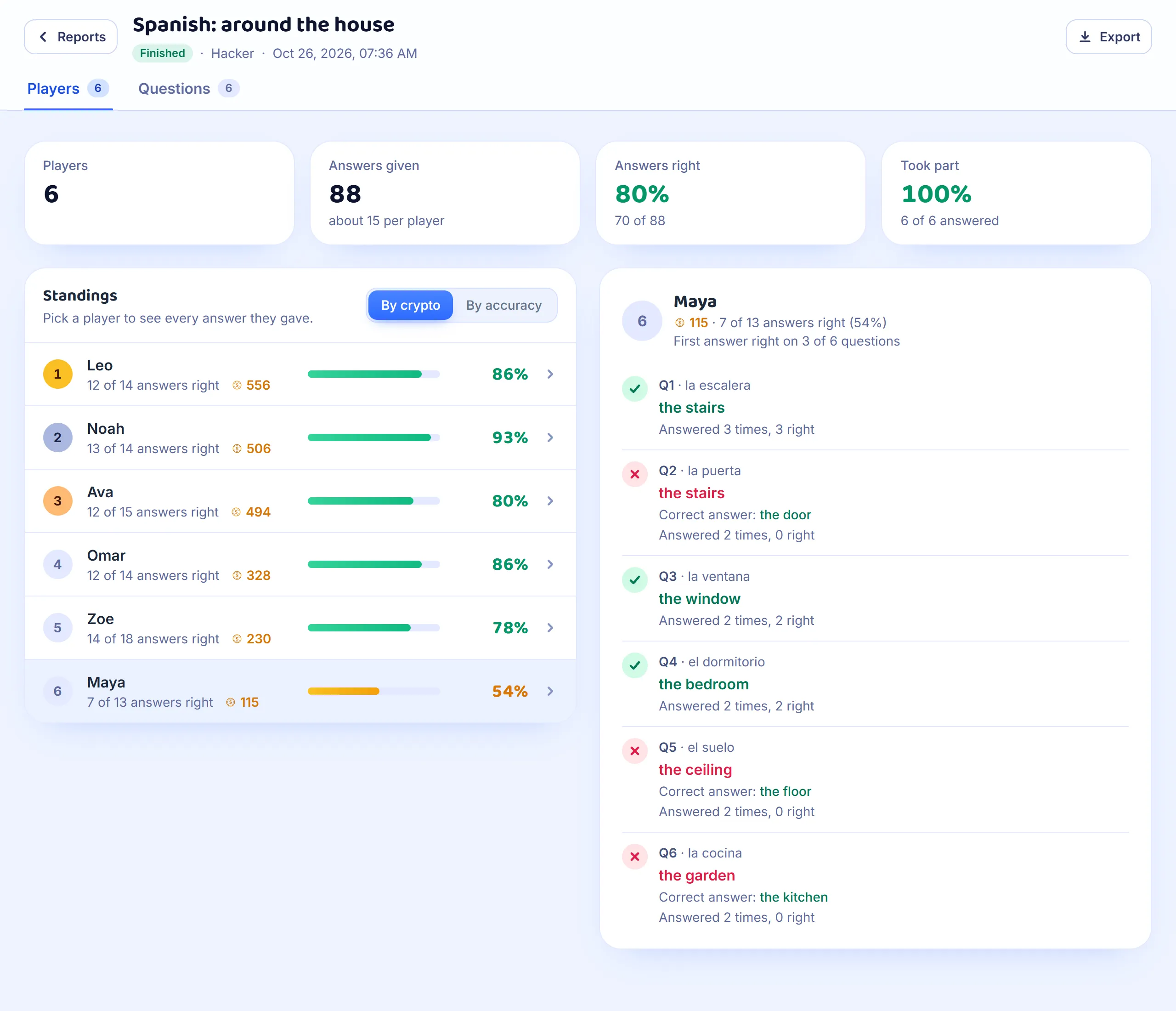
When the game ends, look at accuracy rather than crypto, since crypto also depends on the luck of the vaults. The report lists every word each student was asked, how they answered it the first time, and how often they got it right when it came round again. A word missed the first time and right every time after is a word learned during the game. A word the whole room keeps missing is next week’s starting point.
Sources
- Karpicke, J. D. & Roediger, H. L. (2008). The critical importance of retrieval for learning. Science, 319(5865), 966–968.
- Webb, S. (2007). The effects of repetition on vocabulary knowledge. Applied Linguistics, 28(1), 46–65.
Try it in Giga Quizzes
Free, in the browser, and nothing for your students to install. These guides show each step on the real screens.
New to Giga Quizzes?
Free live quizzes in the browser. Students join from any phone, with no app.
Make your first quiz →