Multiple Choice or Typed Answer? Choosing the Right Question
Choosing an answer tests recognition; typing one tests recall. The same question asked both ways, what the research says about each, and a simple way to decide.
 By the Giga Quizzes team4 min read

In this post
Picking the right answer out of four and producing it from memory are two different skills. A student who recognises “mitochondria” the moment they see it may still be unable to come up with the word on their own. Neither kind of question is the better one; they measure different things, and they help memory in different ways. Knowing which you need is what makes a quiz tell you something true about your class.
One idea, asked two ways
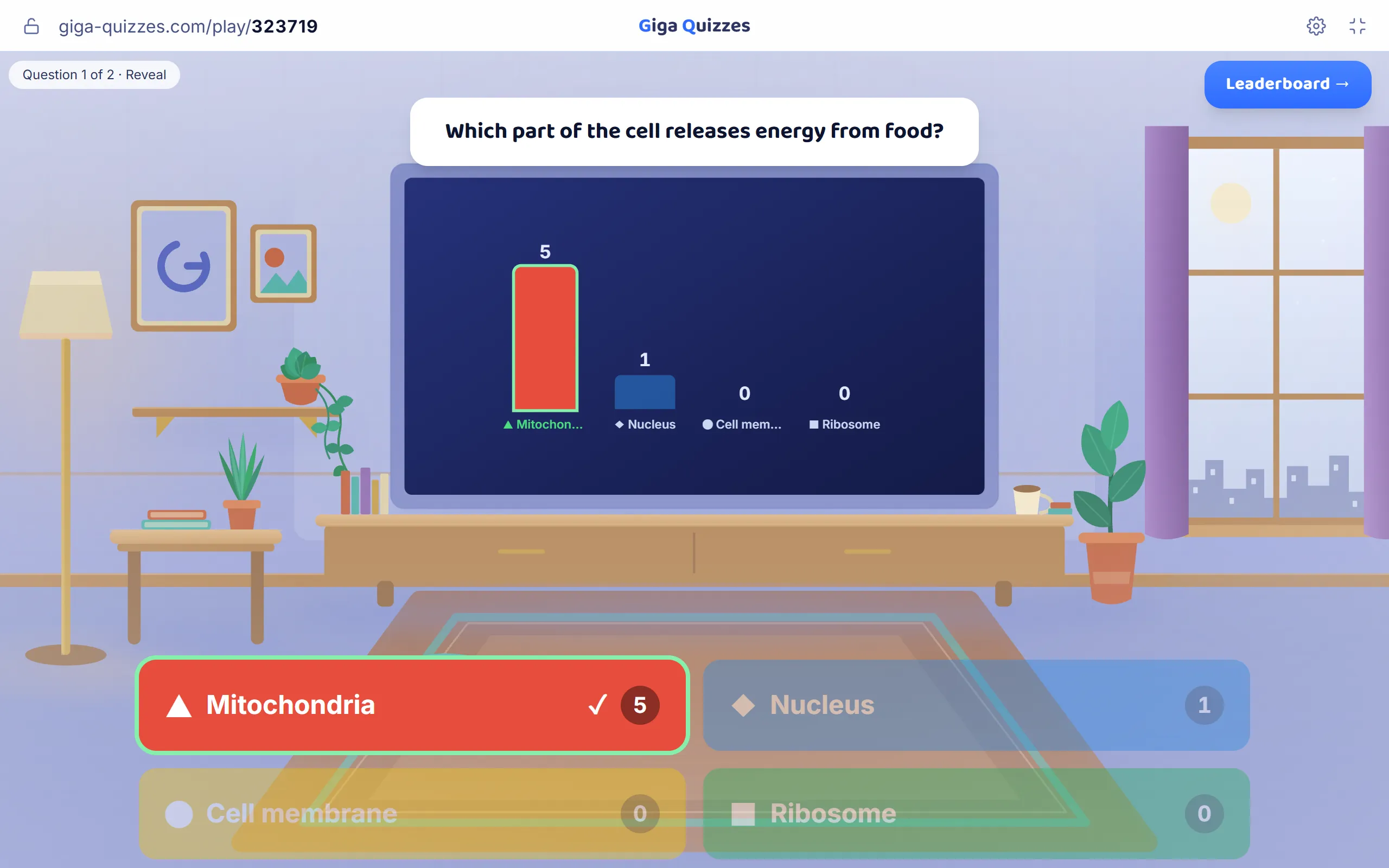
Here is the same science question asked twice to the same six students, a few minutes apart. First as multiple choice: which part of the cell releases energy from food? Five of the six chose mitochondria.
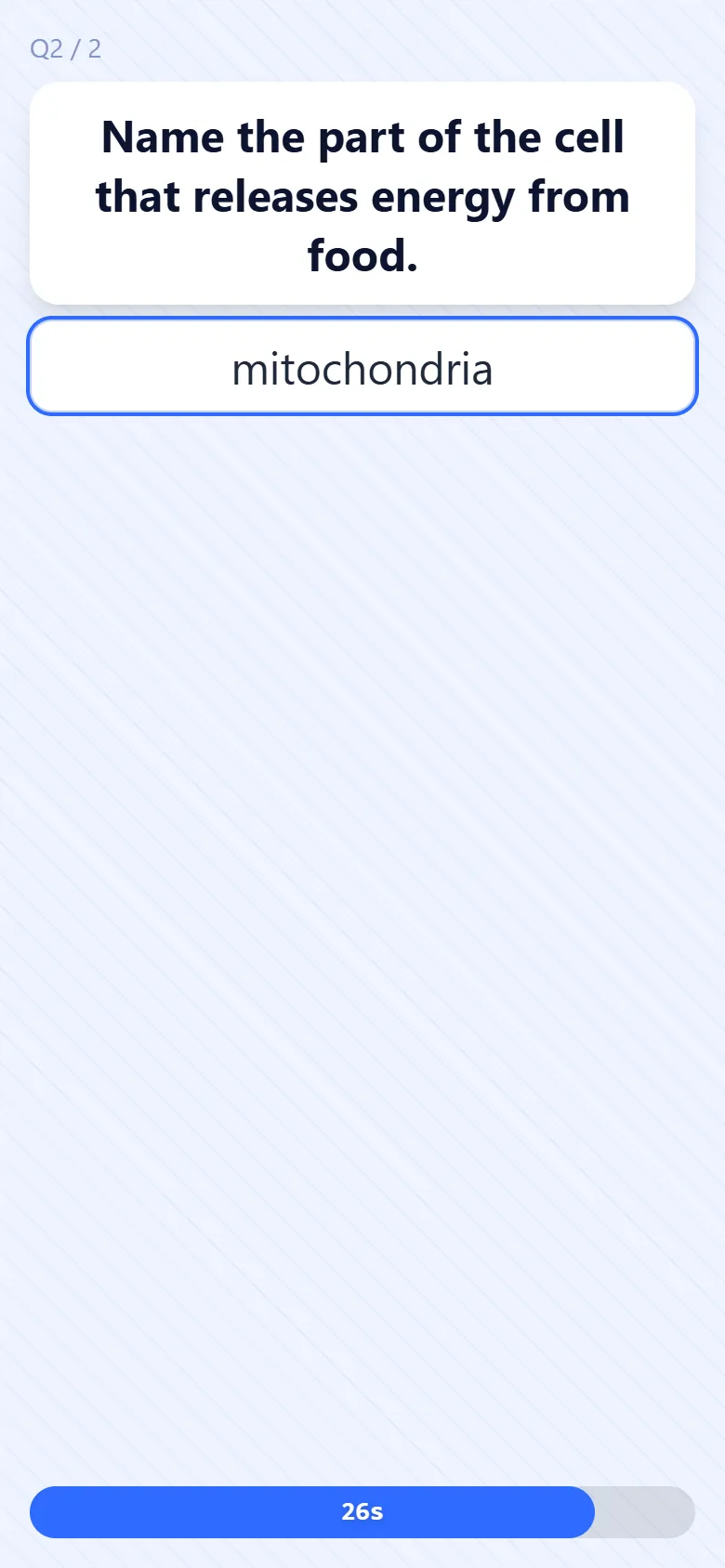
Then with no options at all: name the part of the cell that releases energy from food. This time students had to produce the word from memory and spell it well enough to be recognised.
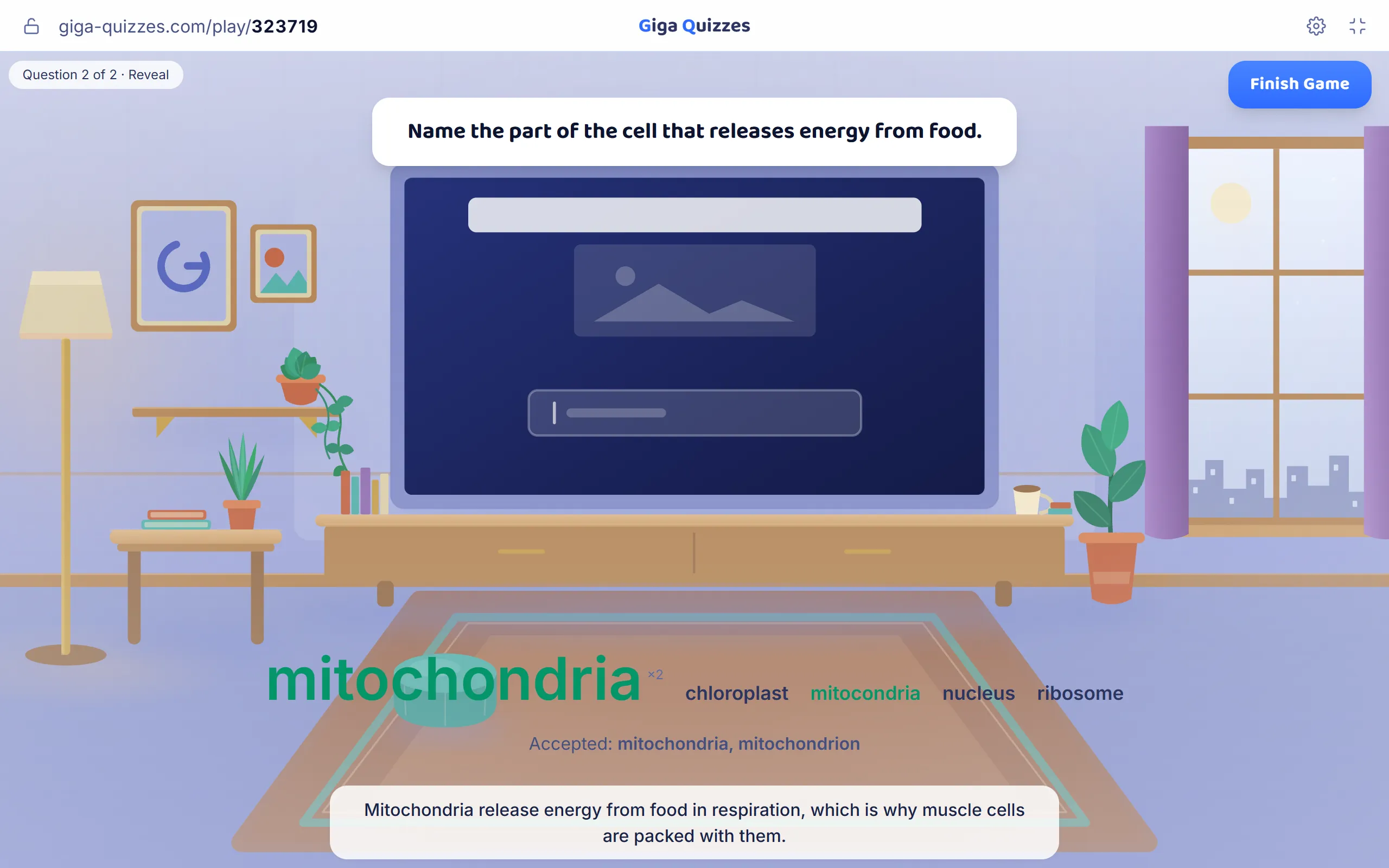
Only three got it. One misspelled it but close enough to count; the other three wrote the nucleus, a chloroplast and a ribosome. Same class, same idea, very different picture. The multiple-choice result said the class knew it. The typed result said half of them only recognised it.
Recognition and recall
Multiple choice asks students to recognise the right answer among others. That makes it fast, fair to students who write slowly, and comfortable on a phone. It is the right tool for checking that a class can tell an idea apart from its neighbours: which of these is a prime number, which of these is a cause of the war, which sentence uses the past tense correctly. With wrong answers built from real mistakes, it also shows you which misunderstanding is the most common.
A typed answer asks students to recall. There is no list to jog the memory and nothing to eliminate, so a right answer means the student really has it. It is the better test for anything students must produce on their own: vocabulary in a new language, the name of a process, a key term they will need in an exam.
What the research says
Both kinds of question do more than measure: answering them strengthens memory too. Which strengthens it more depends on what happens after the answer.
Sean Kang, Kathleen McDermott and Henry Roediger compared short-answer and multiple-choice quizzes on the same material. When students got no feedback, multiple choice did better on a later test, because students who could not recall an answer on the short-answer quiz were left with nothing. When students were shown the right answer after each question, the short-answer quiz did better. Recall is the stronger practice, as long as students find out the answer straight away.
Multiple choice is not a lesser cousin, though. Jeri Little and colleagues found that multiple-choice questions with plausible wrong answers made students think about why each option was wrong, which helped them later with related questions about those wrong options too. The quality of the wrong answers decides how much a multiple-choice question teaches.
A simple way to decide
Ask what a right answer should prove.
| A right answer should prove the student can… | Use |
|---|---|
| Tell the right idea apart from similar ones | Single choice |
| Find every right idea in a group | Select all that apply |
| Remember the word with no help at all | A typed answer |
| Remember it with a sentence around it as a clue | Fill in the blank |
| Work out a value | A number answer |
Most good quizzes use more than one. A pattern that works across a unit is to start with multiple choice while the ideas are new, move to fill in the blank as they settle, and finish with typed answers in the week before the test.
Making typed answers fair
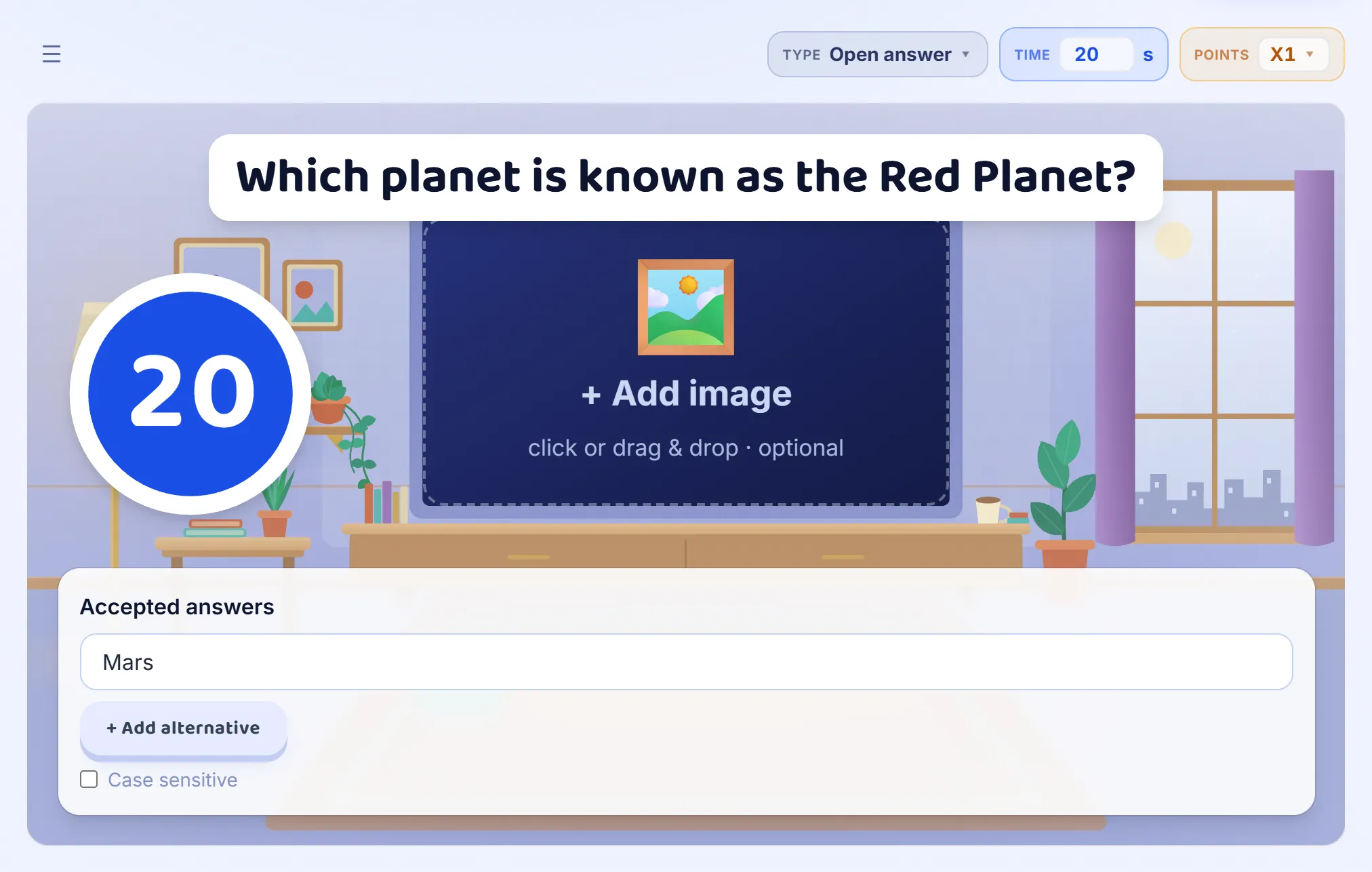
The usual worry about typed answers is spelling. In Giga Quizzes, an Open answer question takes a list of Accepted answers, such as a short form, a long form and a common synonym. Capitals, spaces and punctuation are ignored, and one wrong letter in a longer word is forgiven as long as the first letter is right, which is how “mitocondria” counted above. When spelling is the point, as in a language class, tick Case sensitive and only the exact answer counts.
Three rules for typed questions
- One or two words. A sentence cannot be marked fairly by a machine, and takes too long under a timer.
- More time. Typing on a phone is slower than anyone expects: give at least thirty seconds, more for younger students.
- Think of the alternatives before the game, not after a student protests that “the powerhouse of the cell” should count.
In between: blanks and numbers
Fill in the blank sits halfway between the two. Students type the missing words, so it is recall, but the sentence around the gap gives them a foothold. Each blank is scored on its own, so a student who fills one of two gaps correctly gets half the credit, which suits a class moving from recognition towards recall.
For maths and science, a number answer lets students type a value, with a tolerance so that 9.8 is not marked wrong for missing 9.81. For younger classes it can switch to options instead, where students tap the number from a few tiles. Choose those wrong numbers from real slips, and you get the speed of multiple choice with the precision of a number. The maths quiz guide shows both.
Sources
- Kang, S. H. K., McDermott, K. B. & Roediger, H. L. (2007). Test format and corrective feedback modify the effect of testing on long-term retention. European Journal of Cognitive Psychology, 19(4–5), 528–558.
- Little, J. L., Bjork, E. L., Bjork, R. A. & Angello, G. (2012). Multiple-choice tests exonerated, at least of some charges: Fostering test-induced learning and avoiding test-induced forgetting. Psychological Science, 23(11), 1337–1344.
Try it in Giga Quizzes
Free, in the browser, and nothing for your students to install. These guides show each step on the real screens.
New to Giga Quizzes?
Free live quizzes in the browser. Students join from any phone, with no app.
Make your first quiz →