When True or False Works, and When It’s Too Easy
True or false is quick to write and quick to answer, but a coin toss gets half of it right. The numbers behind guessing, where these questions shine, and a ready-made myth-busting round.
 By the Giga Quizzes team4 min read

In this post
True or false is the fastest question there is: a minute to write, a second to answer, and nobody is left out. Its weakness is just as obvious. A student who knows nothing at all still gets half of them right. Used in the right place, it is one of the sharpest tools a quiz has, especially for catching beliefs students hold without realising. Used everywhere, it turns a quiz into a coin toss. This post shows where the line is.
The arithmetic of guessing
It helps to see the numbers. Imagine a student who knows nothing and guesses every answer on a ten-question quiz.
| Ten questions of… | Average score from guessing | Chance of 7 or more by luck alone |
|---|---|---|
| True or false | 5 out of 10 | About 1 in 6 |
| Multiple choice with four answers | 2.5 out of 10 | About 1 in 300 |
One student’s seven out of ten on a true-or-false quiz could be real knowledge or a lucky streak. Across a whole class the picture is clearer: if most of the room gets a true-or-false question wrong, that is not chance. Something they believe is pulling them the wrong way, and that is exactly where this question type earns its place.
Where it shines: beliefs students already hold
The best true-or-false questions go straight at a myth. Everyone has heard that bats are blind, that lightning never strikes the same place twice, or that the Great Wall of China can be seen from the Moon. All three are false, and students do not guess at them; they answer “true” with confidence. A true-or-false question brings that belief into the open in one tap.
What happens next matters most. Science education researchers have studied “refutation texts”, short passages that state a common misconception, say plainly that it is wrong, and explain the correct idea. A review by Christine Tippett found them consistently useful for changing students’ minds. A myth question followed by a one-line explanation at the reveal is the same move: the belief, the correction and the reason, in that order, while students still care about the answer.
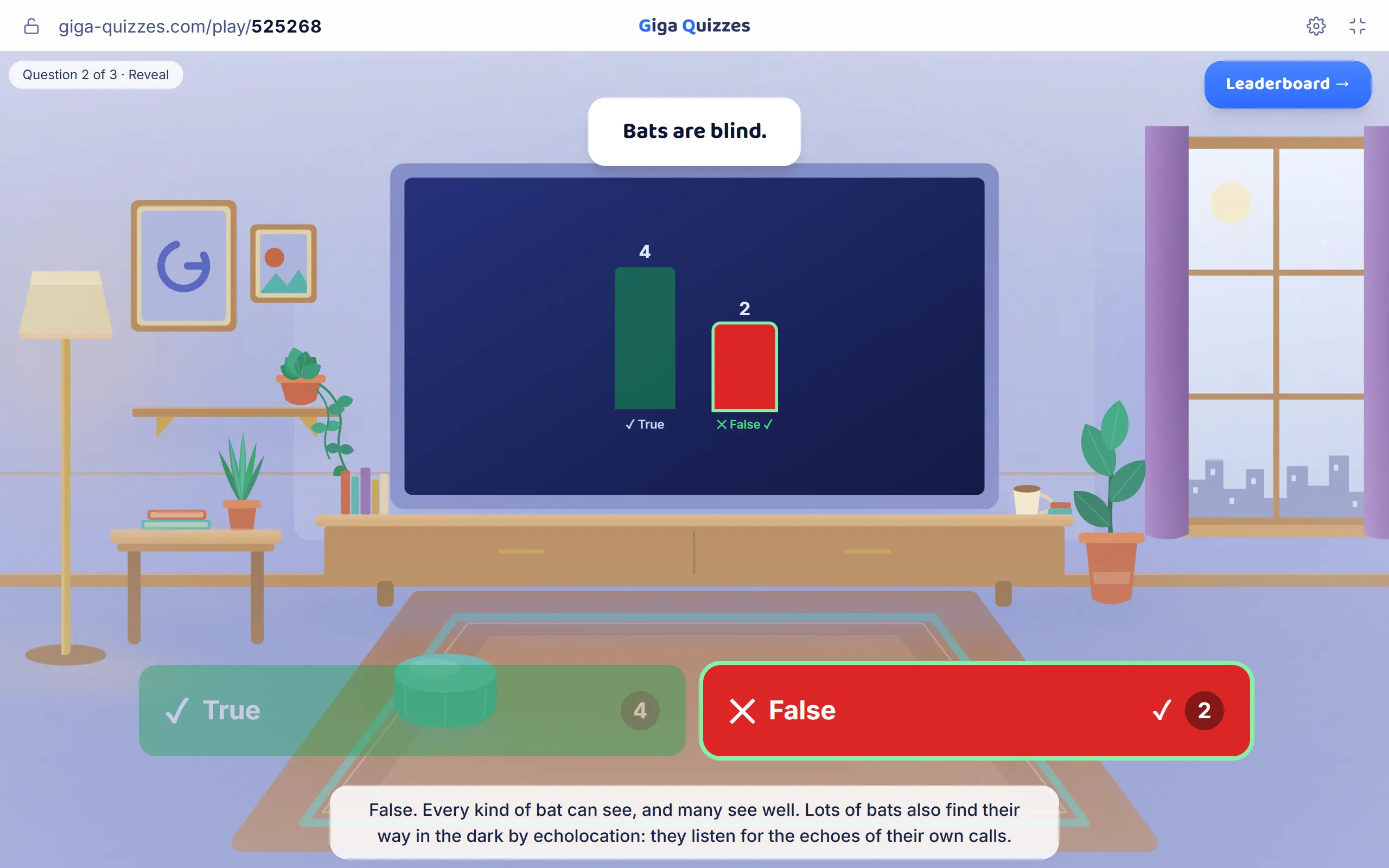
The student who answered “true” sees why straight away, on their own phone, in the seconds when they most want to know.
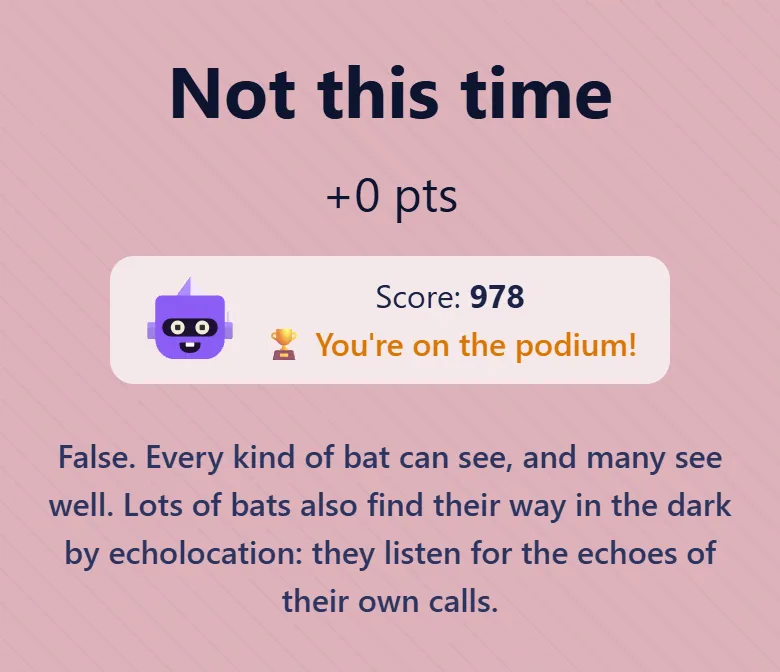
A myth-busting round to borrow
Mix in a few surprising truths so that students cannot simply answer “false” every time.
Ten statements, with answers
- Bats are blind. (False: all bats can see, and many also use echolocation.)
- Octopuses have three hearts. (True.)
- The Great Wall of China is visible from the Moon with the naked eye. (False: it is far too narrow.)
- A day on Venus is longer than its year. (True: it spins so slowly that one turn takes longer than one trip round the Sun.)
- Lightning never strikes the same place twice. (False: tall buildings are struck many times a year.)
- Bananas are berries, botanically speaking. (True.)
- Goldfish have a memory of only a few seconds. (False: they can learn and remember for months.)
- Bulls charge at the colour red. (False: it is the movement of the cape that provokes them.)
- Sound travels faster in water than in air. (True: about four times faster.)
- We only use ten per cent of our brains. (False: brain scans show activity throughout the brain.)
Writing a good true-or-false statement
- One idea per statement. “Water boils at 100°C at sea level and freezes at 10°C” is half true, and students cannot tell which half you are marking.
- No giveaway words. Statements with “always” or “never” are usually false, and test-wise students know it. Statements with “sometimes” are usually true.
- Balance the answers. If eight of ten statements are true, students learn to press true. Aim for roughly half and half.
- No negatives. “Mercury is not the smallest planet” makes students untangle the grammar before they can think about planets.
- Believable false statements. An obviously false statement is a free point. The good ones are what a student who half-learned the topic would accept.
Keep the points low
Since a guess pays off half the time, a true-or-false question should not decide who wins. In Giga Quizzes, the Points setting above each question runs from ×0 to ×3. Leave true or false at ×1, or ×0 for a warm-up, and keep ×2 and ×3 for questions where a right answer really shows understanding.
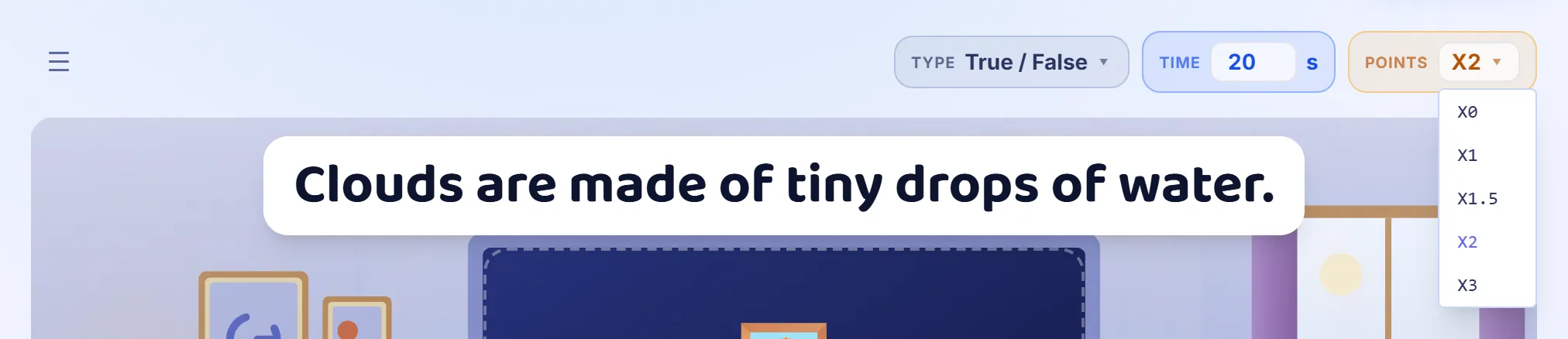
Mixing types keeps a quiz honest. Two or three true-or-false questions among single choice, typed answers and ordering give the class some quick wins without letting luck carry anyone to the top.
When single choice is the better question
If you write a statement and find yourself wondering what the other answers would be, turn it into a single-choice question. “The heart has four chambers: true or false?” becomes “How many chambers does the human heart have?” with 2, 3, 4 and 6 as options. A guess now pays off one time in four, and the wrong answers tell you something.
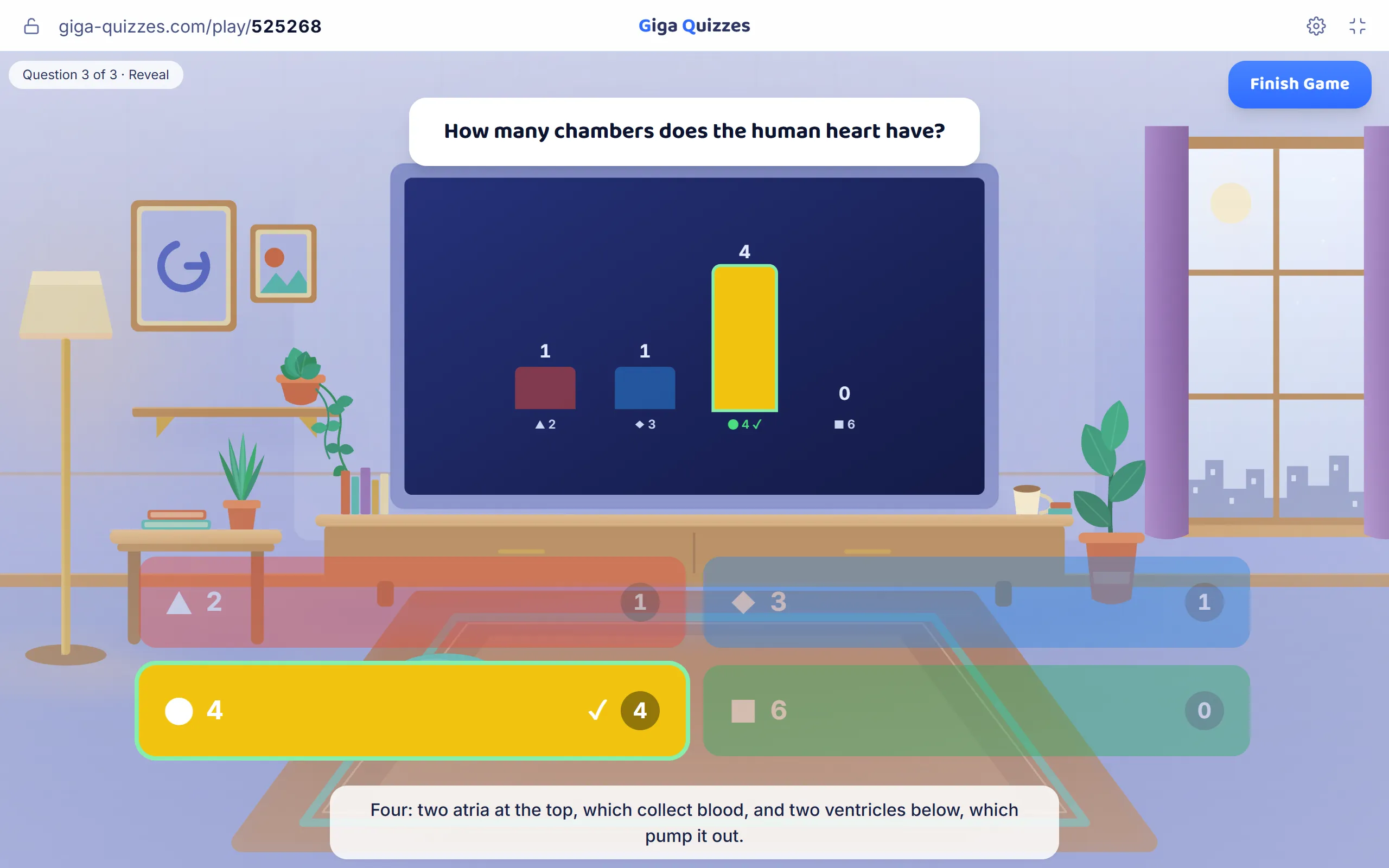
That is the real limit of true or false. It can tell you a student is wrong, but not how they are wrong. A student who says the heart has two chambers is mixing it up with something different from one who says six, and only a question with several answers can show you the difference.
Where it fits in a lesson
| Use true or false for… | Use something else for… |
|---|---|
| A fast warm-up, with everyone answering in seconds | Deciding who wins the game |
| Bringing a myth or misconception into the open | Checking an explanation or a process |
| One sharp fact: a rule, a date, a definition | Finding out which mistake a student is making |
| Younger readers, or a class working in a second language | A topic where the interesting part is why |
Sources
- Tippett, C. D. (2010). Refutation text in science education: A review of two decades of research. International Journal of Science and Mathematics Education, 8(6), 951–970.
Try it in Giga Quizzes
Free, in the browser, and nothing for your students to install. These guides show each step on the real screens.
New to Giga Quizzes?
Free live quizzes in the browser. Students join from any phone, with no app.
Make your first quiz →