Using Polls to Hear From Quiet Students
A show of hands hears the same five students every time. How live polls give the whole class a voice, the kinds of poll worth asking, and how to turn a result into a discussion.
 By the Giga Quizzes team5 min read

In this post
Ask a question and wait for hands, and the pattern is familiar: the same handful of students answer, and the rest of the room lets them. Plenty of quiet students have a view, sometimes the most interesting one in the class, but saying it in front of thirty people is a big ask. A live poll lowers the bar to a tap. Everyone answers at the same moment, privately, and the result belongs to the whole class. This post covers why that changes what you hear, which polls are worth asking, and how to turn a chart into a conversation.
What a show of hands hides
A raised hand is a public act, and students treat it as one. They glance around before deciding, wait to see which way the room is leaning, and often join the majority or sit it out. What you end up measuring is partly what students think and partly how brave they feel.
Researchers have seen this directly. Jeffrey Stowell and Jason Nelson asked the same review questions in a psychology class in different ways. With a show of hands, the answers drifted towards what others were choosing, and more students got questions right in class than later managed on their own. With anonymous electronic responses, more students took part and their answers were more honest about what they actually knew.
| A show of hands | A live poll | |
|---|---|---|
| Who answers | The confident few | Everyone with a device |
| When they see the room | Before they decide | Only after they have answered |
| Who can see each answer | The whole class | Nobody but the teacher, later |
| What you learn | What the brave think | What the class thinks |
Five kinds of poll worth asking
A poll works best where every answer is allowed, or where you want to know what the room believes before you teach it. These five cover most lessons:
Polls that earn their place
- Opinion: “Was the narrator telling the truth?” “Which invention changed daily life the most?”
- Prediction: “What will happen to the balloon when we put it in the freezer?” Ask before the demonstration and compare afterwards.
- Confidence: “How sure do you feel about adding fractions?” from “I could teach it” down to “I’m lost”.
- Choice: “Which topic should Friday’s review cover?” The class decides, and knows it decided.
- One word: “Sum up the poem in one word.” Typed answers become a word cloud in seconds.
Keep the answers short and mutually exclusive, and offer a neutral way out such as “Not sure yet” when the question is about opinions. Two to four answers is plenty; six options on a phone screen start to feel like a test.
A worked example: phones at lunch
Here is how one poll plays out in a citizenship lesson. The question is one every student has an opinion on: should phones be allowed at lunch break? Four answers, no right one, thirty seconds on the clock.
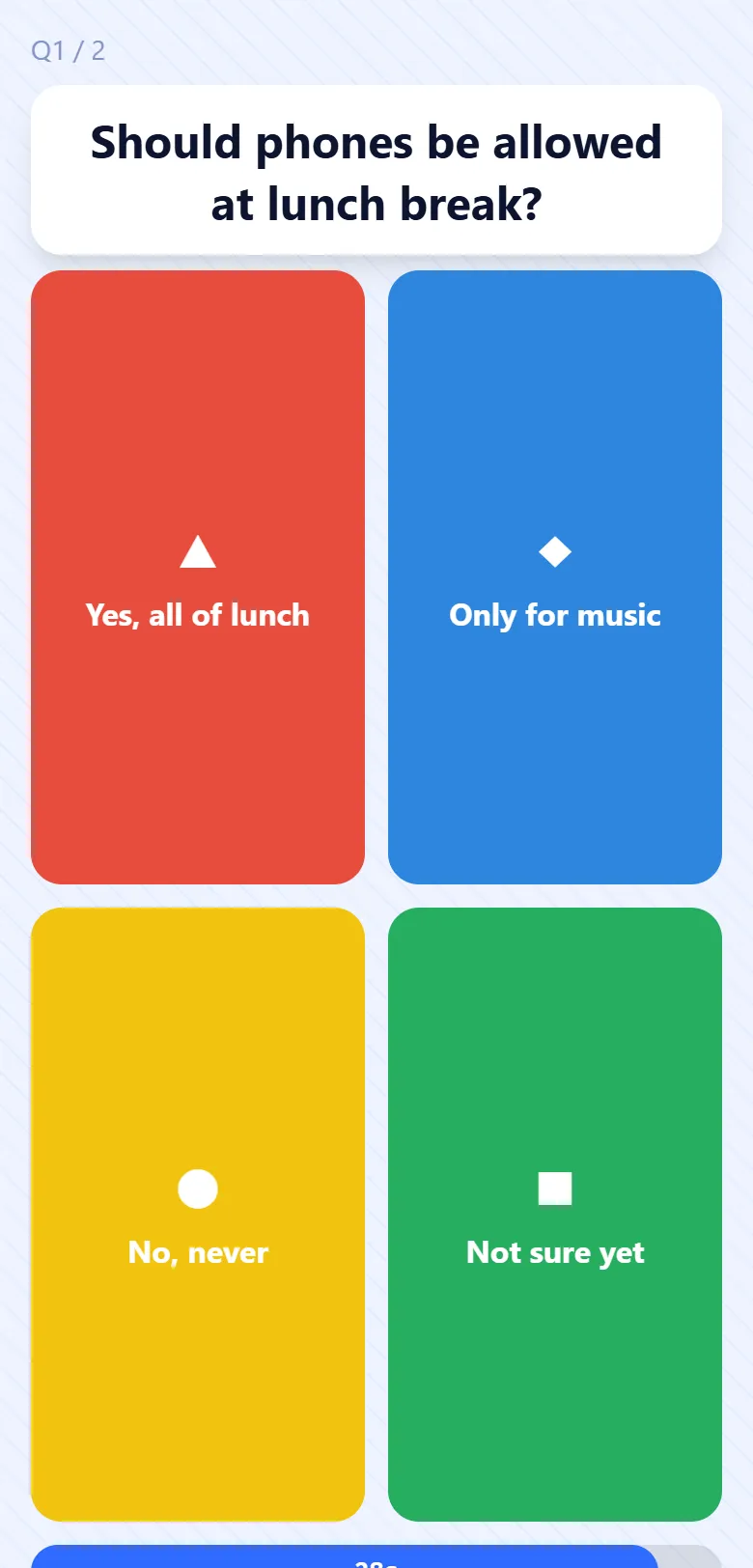
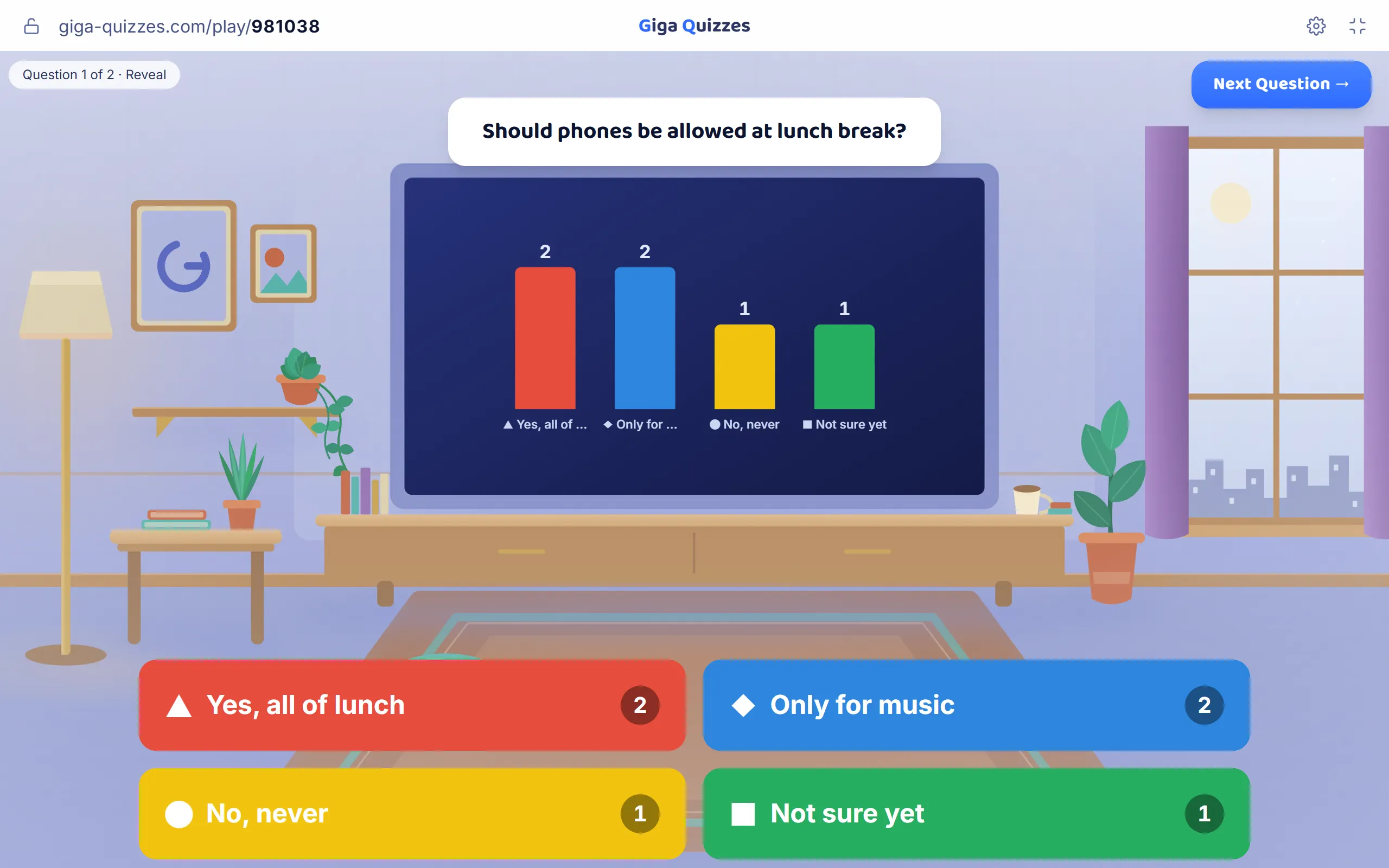
When the time runs out, the chart goes up. In this class the room split three ways, with one student still undecided. That is a far better starting point for a discussion than the two loudest students arguing while everyone else watches, because every student is now somewhere on that chart and wants to know how the others got there.
Vote, talk, vote again
The most useful thing you can do with a split result is not to settle it. Let the class settle it.
- Put the result up and say nothing about which answer you prefer.
- Ask the room why someone might have chosen the least popular answer. Students can defend an idea without admitting it was theirs.
- Pair up students who chose differently and give them two minutes to convince each other.
- Run the same poll again and compare the two charts.
For questions that do have a right answer, this routine has good evidence behind it. Michelle Smith and colleagues ran it in a university genetics course: students answered a concept question, discussed it with their neighbours, and answered again. They then got a new question on the same idea, alone, and did better on it, even in groups where nobody had known the answer at the start. Talking it through built understanding, not just copying.
The second chart is often the best moment of the lesson. When a quarter of the room changes its mind, everyone can see that thinking happened, and the quiet students were part of it.
The confidence check
The simplest poll may be the most useful one. After teaching something new, ask the class how sure they feel. A student who would never put a hand up to say “I don’t get it” will tap “I’m not sure” without a second thought.
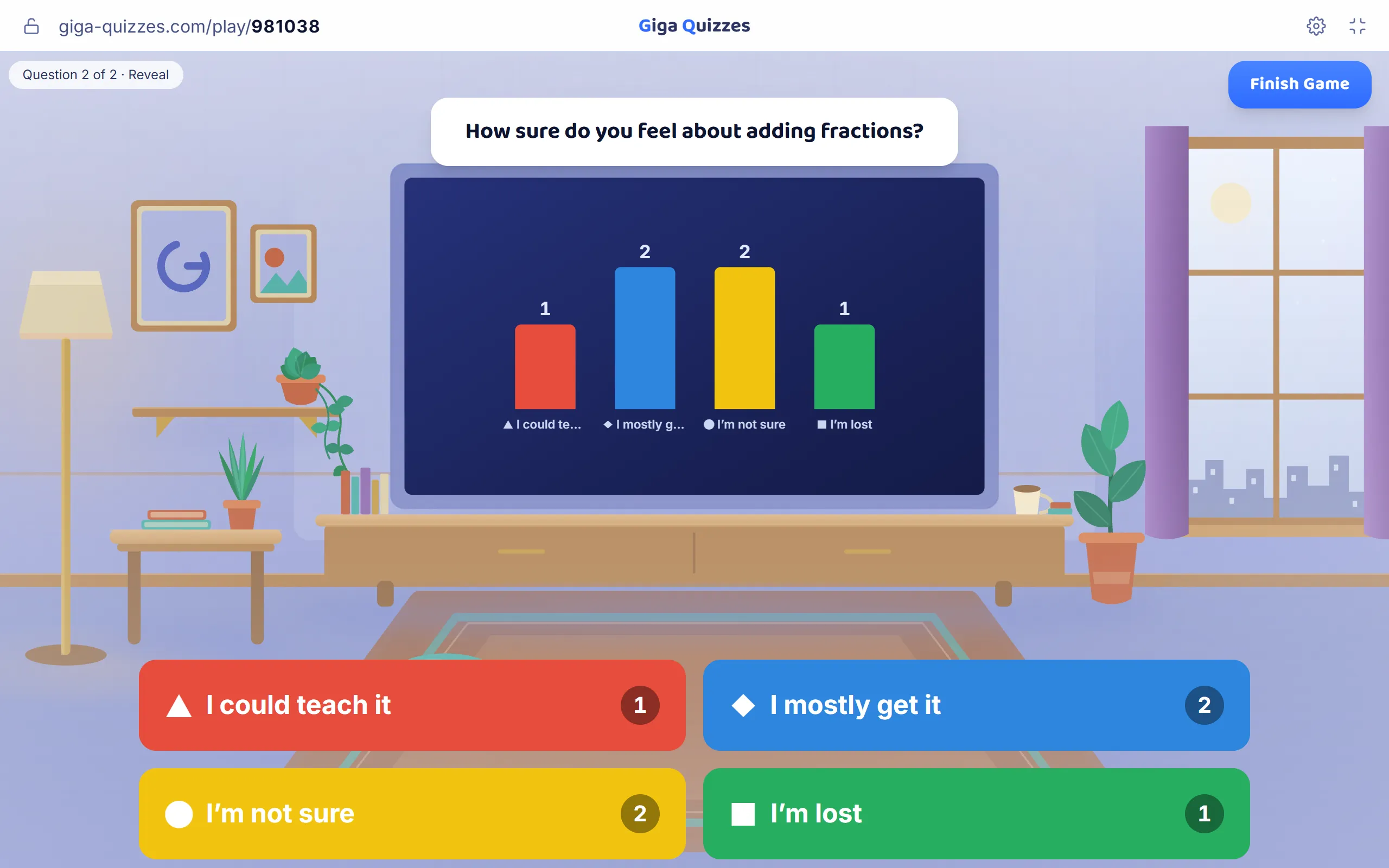
Read it alongside the real answers. Put the confidence poll straight after three questions on the new idea, and look at both together. A class that feels unsure but answered well needs encouragement; a class that feels sure but answered badly needs another look before the misunderstanding sets.
Setting it up
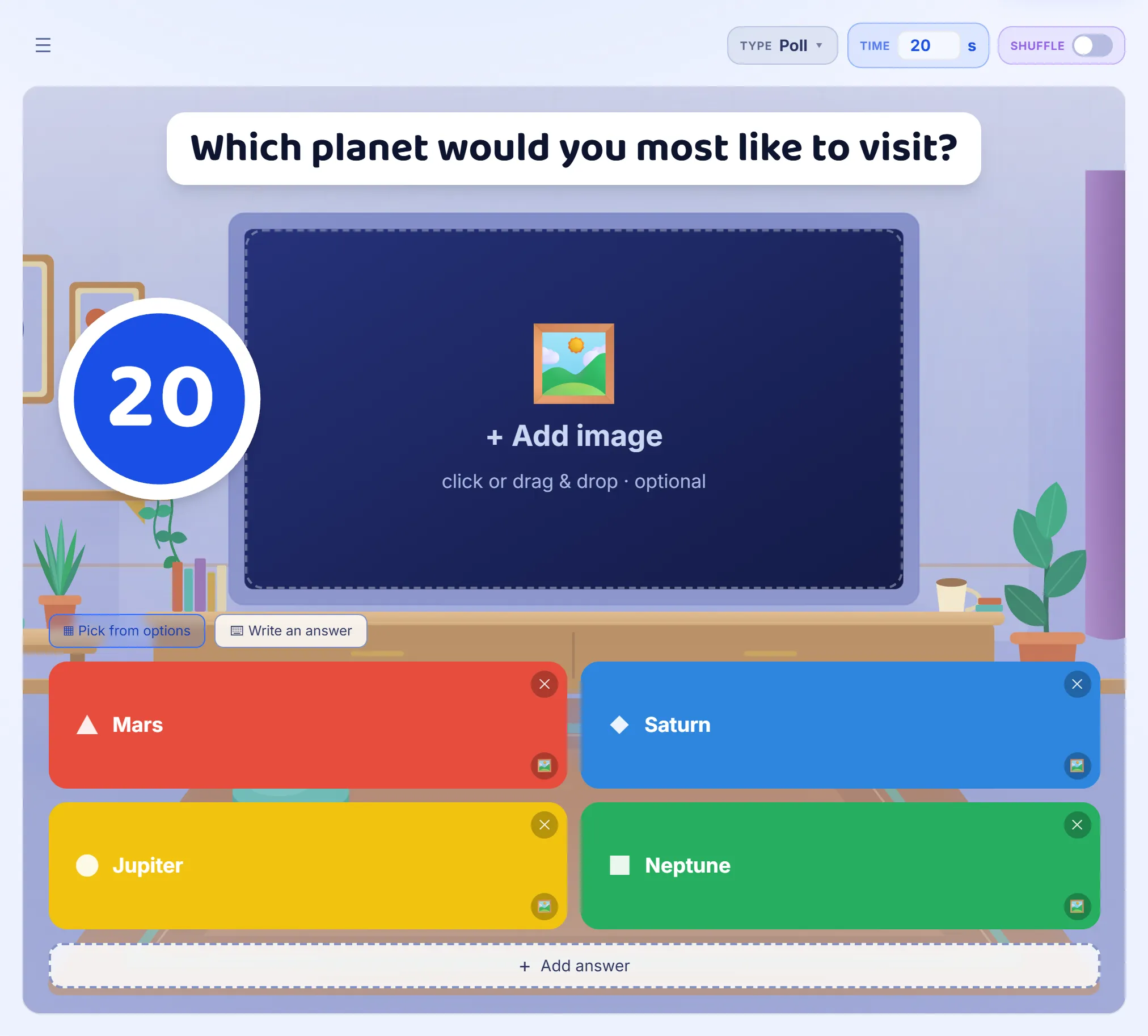
In Giga Quizzes, a Poll is a question type with no right answer and no points, so it never moves the leaderboard and can sit between scored questions without changing the game. Students tap one of your answers and the big screen draws a bar for each. Switch the poll to Write an answer and they type instead; the most common words come up largest in a word cloud. If students should read the question on their own phones rather than only on the projector, leave Phones show colors only off in Game settings.
Keep the trust
A poll only stays honest while students believe it is safe. Three habits protect that. Never ask “who voted for this?” about a sensitive question, even as a joke. Talk about the answers, not the people who gave them. And keep the light polls coming as well as the serious ones: a quick “cats or dogs?” at the start of a lesson gets every phone answering and makes the next, harder poll feel normal.
Over a few weeks the effect is easy to notice. Students who never spoke start explaining their vote, because they have already seen that the room is not as united as it looked, and that their view has company.
Sources
- Stowell, J. R. & Nelson, J. M. (2007). Benefits of electronic audience response systems on student participation, learning, and emotion. Teaching of Psychology, 34(4), 253–258.
- Smith, M. K., Wood, W. B., Adams, W. K., Wieman, C., Knight, J. K., Guild, N. & Su, T. T. (2009). Why peer discussion improves student performance on in-class concept questions. Science, 323(5910), 122–124.
Try it in Giga Quizzes
Free, in the browser, and nothing for your students to install. These guides show each step on the real screens.
New to Giga Quizzes?
Free live quizzes in the browser. Students join from any phone, with no app.
Make your first quiz →