Teaching in the Reveal: The Moment After the Answer
The seconds after a quiz answer appears are the best teaching moment of the lesson. How to read the answer chart, question the popular wrong answer and make the correction stick.
 By the Giga Quizzes team5 min read

In this post
Every student in the room has just committed to an answer, and for a few seconds they all want the same thing: to know whether they were right. Nobody is looking out of the window. That moment, the reveal, is the most teachable minute a quiz has to offer, and it is the one most games rush past on their way to the leaderboard. Here is how to use it, what to say, and why a correction made at that instant tends to last.
Read the chart before you say anything
When a question closes, look at how the answers are spread before you look at how many were right. The shape of the chart tells you what kind of problem you have, and each shape calls for a different response.
| What you see | What it usually means | What to do |
|---|---|---|
| Nearly everyone right | The idea has landed | Say so in a sentence and move on |
| Answers spread over every option | The class is guessing | Teach it again, ideally in a different way from the first time |
| A big group on one wrong option | A shared misconception | Stop here: this is the reveal worth the time |
| Almost everyone on the same wrong option | The question, or the teaching, misled them | Check your wording first, then reteach |
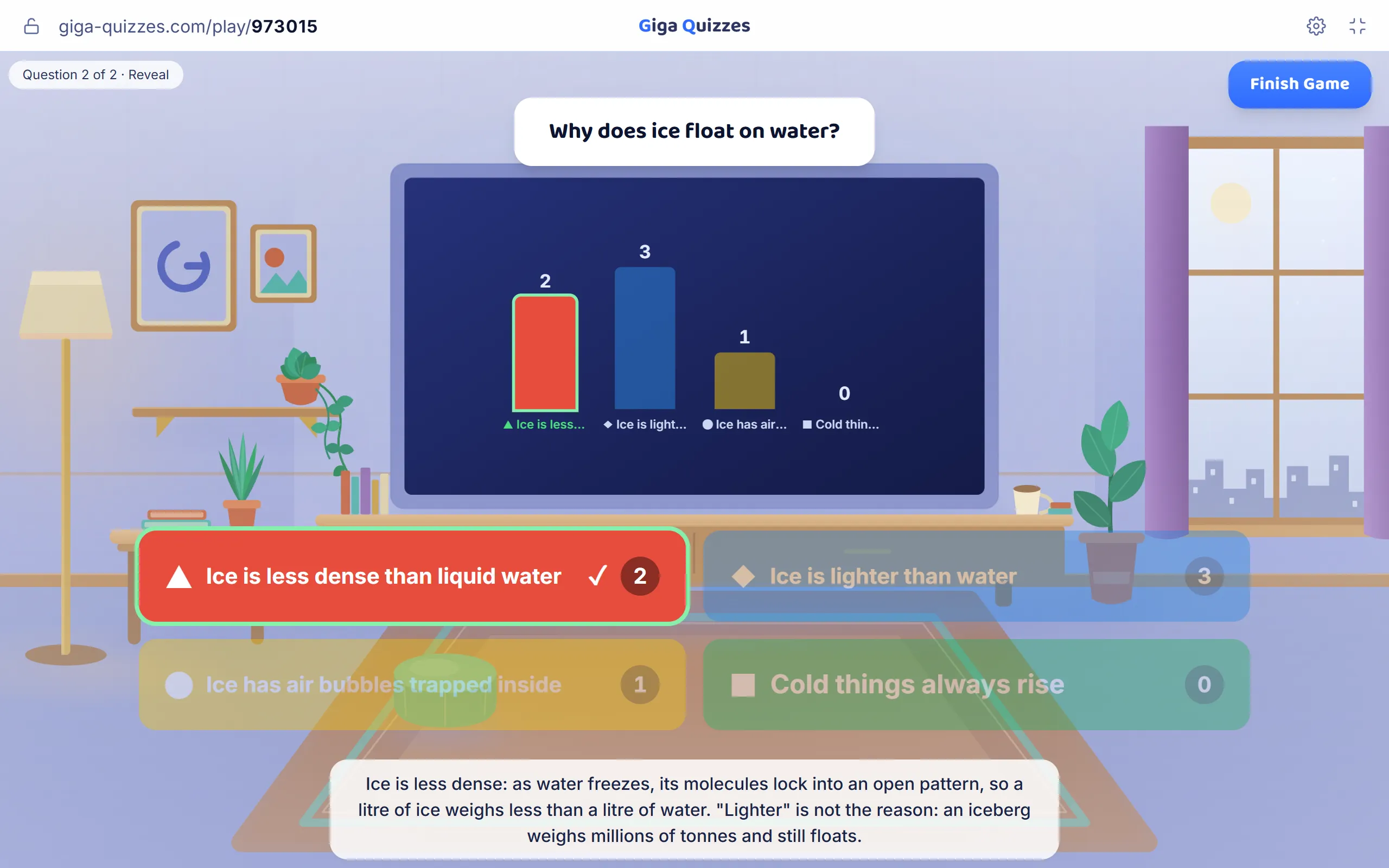
The third row is the one to watch for. A spread of answers is noise. A cluster on one wrong option is a signal: those students were not guessing at random, they were following a line of reasoning that makes sense to them and goes wrong in one particular place. Find that place and you fix the idea for all of them at once.
Ask why the wrong answer looked right
The natural move is to announce the right answer and explain it. Try asking about the popular wrong one first. Not “who chose B?”, which puts students on the spot, but why somebody might have.
Questions that open up a wrong answer
- “What would you have to believe for B to be right?”
- “B is true about something. What is it true about?”
- “What is the difference between B and the right answer?”
- “Can you think of a case where B really would be the answer?”
Someone nearly always offers the reasoning, and it is usually sensible: a real idea applied in the wrong place. Saying that idea out loud, and showing where it stops working, is what changes minds. A student who only learns that the answer was A will fall for B again next week. A student who sees why B looked right usually will not.
Why a correction at this moment sticks
There is good evidence for slowing down here, and some of it is a warning. Multiple-choice questions show students wrong answers, and a student who picks one can go on to remember it as true. In a study by Andrew Butler and Henry Roediger, students who took a multiple-choice test later gave some of its wrong options as answers on a second test, and feedback after the first test sharply reduced that. A quiz that never stops to correct can end up teaching its wrong answers along with its right ones.
The encouraging finding is about confidence. You might expect a student who was sure of a wrong answer to be the hardest to convince. Brady Butterfield and Janet Metcalfe found the opposite: errors made with high confidence were the most likely to be corrected afterwards, an effect they called hypercorrection. Surprise makes people pay attention. The students who chose the popular wrong answer without a moment’s doubt are, in the seconds after the reveal, the ones most ready to learn.
A worked example: why does ice float?
Take a science question with four options. Ice floats because it is less dense than liquid water, which is right; because it is lighter; because it has air bubbles trapped inside; or because cold things rise. Each wrong option stands for a different misunderstanding, so each one gets its own sentence:
- Lighter confuses weight with density. An iceberg weighs millions of tonnes and still floats; what matters is how much a given volume weighs.
- Air bubbles invents a cause. Perfectly clear ice, with no bubbles at all, floats just as well.
- Cold things rise has the usual pattern the wrong way round. Cold air sinks, and so does cold water in most lakes and seas.
Going through all three takes about a minute. It clears up three separate misunderstandings, for the students who held them and for the ones who chose the right answer without being quite sure why.
Write the explanation before the lesson
You cannot stop for a discussion on every question, and you do not need to. For the questions you move past, a written explanation does part of the work. In Giga Quizzes, the Explanation box under each question holds a sentence or two that appears at the reveal, under the chart on the big screen and on every phone, under that student’s own result. A student who got it wrong reads why straight away, even if you have already moved on.
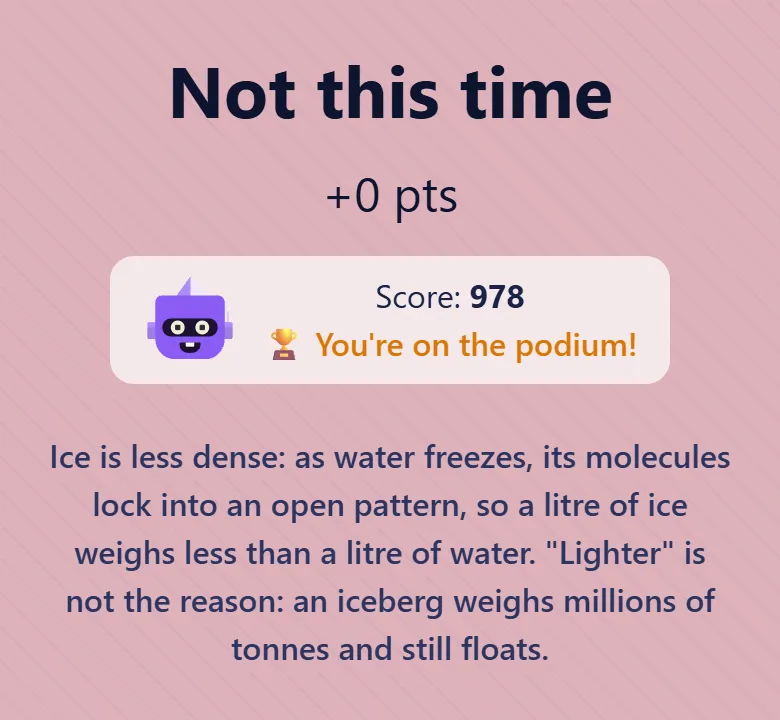
Writing explanations in advance has a useful side effect: it makes you predict the most tempting wrong answer before the class finds it. Keep each one to two sentences. The first says why the right answer is right. The second, if there is room, takes on the wrong answer you expect to be most popular.
Make room for the pause
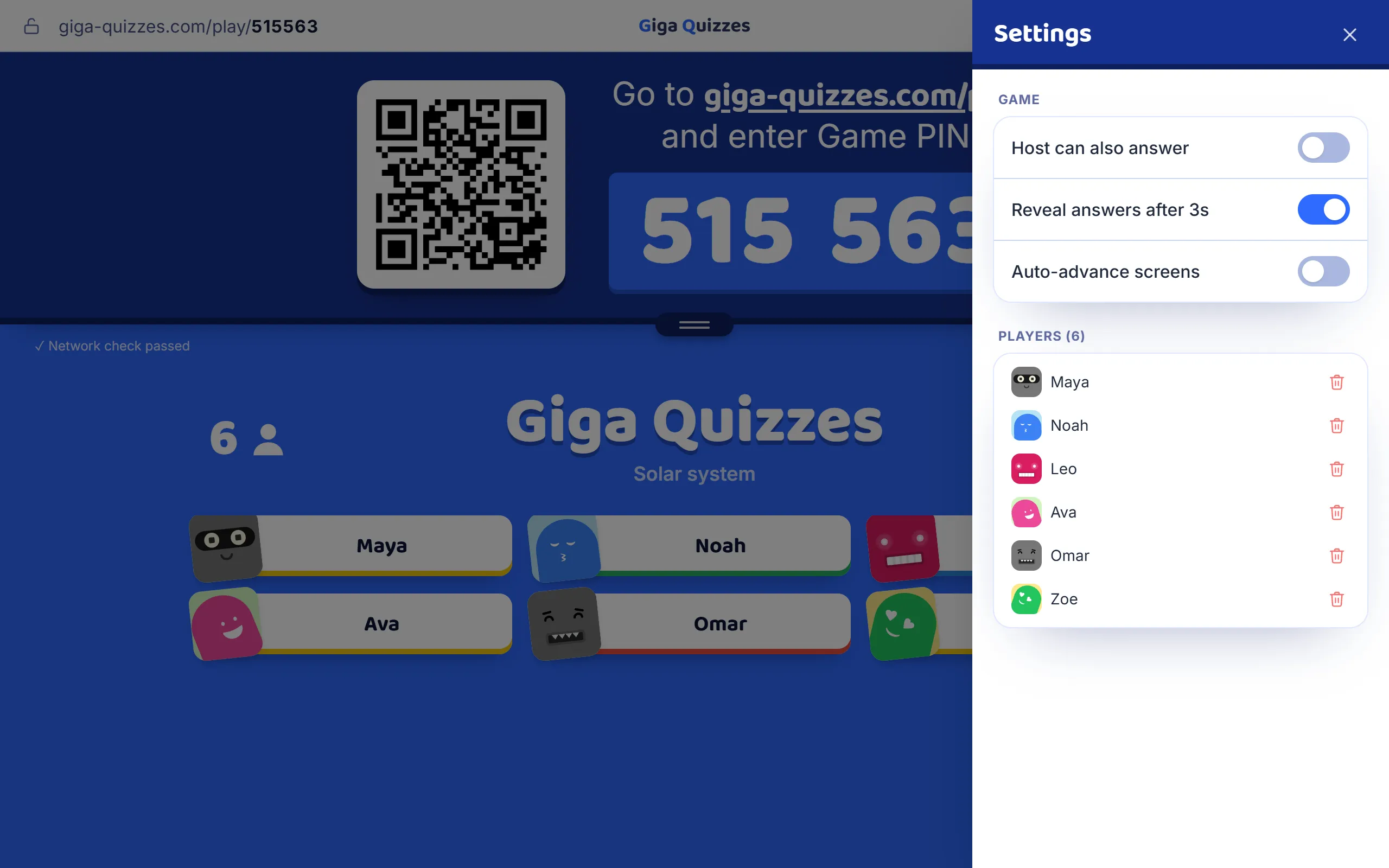
A reveal that moves on after a few seconds keeps the pace up but leaves no time to teach. Switch off Auto-advance screens in the game settings and every reveal waits until you press the button or the space bar. If you prefer the automatic pace for most of the quiz, the lock beside the advance button holds the current screen for as long as you need to talk.
You will not stop on every question, and you should not. A rhythm that works in most lessons is to move briskly through the questions the class got right and stop when the chart shows a cluster. Over a ten-question quiz that usually means two or three stops of a minute or so each, which is a small price for the misconceptions they clear.
Carry it into the next lesson
The reveal tells you what to fix today; the results tell you what to fix tomorrow. The exported question breakdown lists every question from the best answered to the worst, with how many students chose each option, so the most popular wrong answer of the whole quiz is easy to find. Open the next lesson with it: show the question again, ask why that answer was tempting, and see how many still choose it.
Sources
- Butler, A. C. & Roediger, H. L. (2008). Feedback enhances the positive effects and reduces the negative effects of multiple-choice testing. Memory & Cognition, 36(3), 604–616.
- Butterfield, B. & Metcalfe, J. (2001). Errors committed with high confidence are hypercorrected. Journal of Experimental Psychology: Learning, Memory, and Cognition, 27(6), 1491–1494.
Try it in Giga Quizzes
Free, in the browser, and nothing for your students to install. These guides show each step on the real screens.
New to Giga Quizzes?
Free live quizzes in the browser. Students join from any phone, with no app.
Make your first quiz →