Pre-Testing: Why a Quiz Before the Lesson Helps
Asking questions before you teach the answers sounds backwards, but research says it helps students learn. How to write a short, no-stakes pre-test and what its answers tell you.
 By the Giga Quizzes team5 min read

In this post
Quizzing a class on a topic you have not taught yet sounds like a recipe for a room full of wrong answers, and it is. That is rather the point. A short pre-test at the start of a topic makes the lesson that follows stick better, and it shows you, before you say a word, what your class already believes. This post covers the evidence, how to write a pre-test that works, and how to keep it from feeling like an exam.
What the research says
The idea has a name, the pretesting effect, and a solid body of studies behind it. In one well-known experiment, Lindsey Richland, Nate Kornell and Liche Sean Kao gave students a passage to read. Some first answered questions about it, getting most of them wrong; others spent that time reading. On a later test, the students who had tried the questions first remembered the answers better, even though their first attempts had mostly failed.
A 2023 review by Steven Pan and Shana Carpenter pulled together the evidence and drew a practical conclusion: answering questions before learning tends to help, as long as students then get the chance to learn the right answers. That condition matters. A pre-test is not a substitute for teaching; it is a way of getting students ready for it. The benefit is also clearest for the very things the questions asked about, which is a good reason to point a pre-test at the ideas that matter most.
Why does it work? The usual explanation is attention. A student who has guessed that a heavy ball falls faster is now waiting to find out. When the lesson reaches that point, they are listening for the answer to a question they have already asked themselves.
What the answers tell you
The second gift of a pre-test is for you. Its answers are a map of what the class already knows and, more usefully, what it wrongly believes. You might plan three lessons on a topic and find half the class has met it before. Or you might discover that an idea you meant to skim is new to almost everyone.
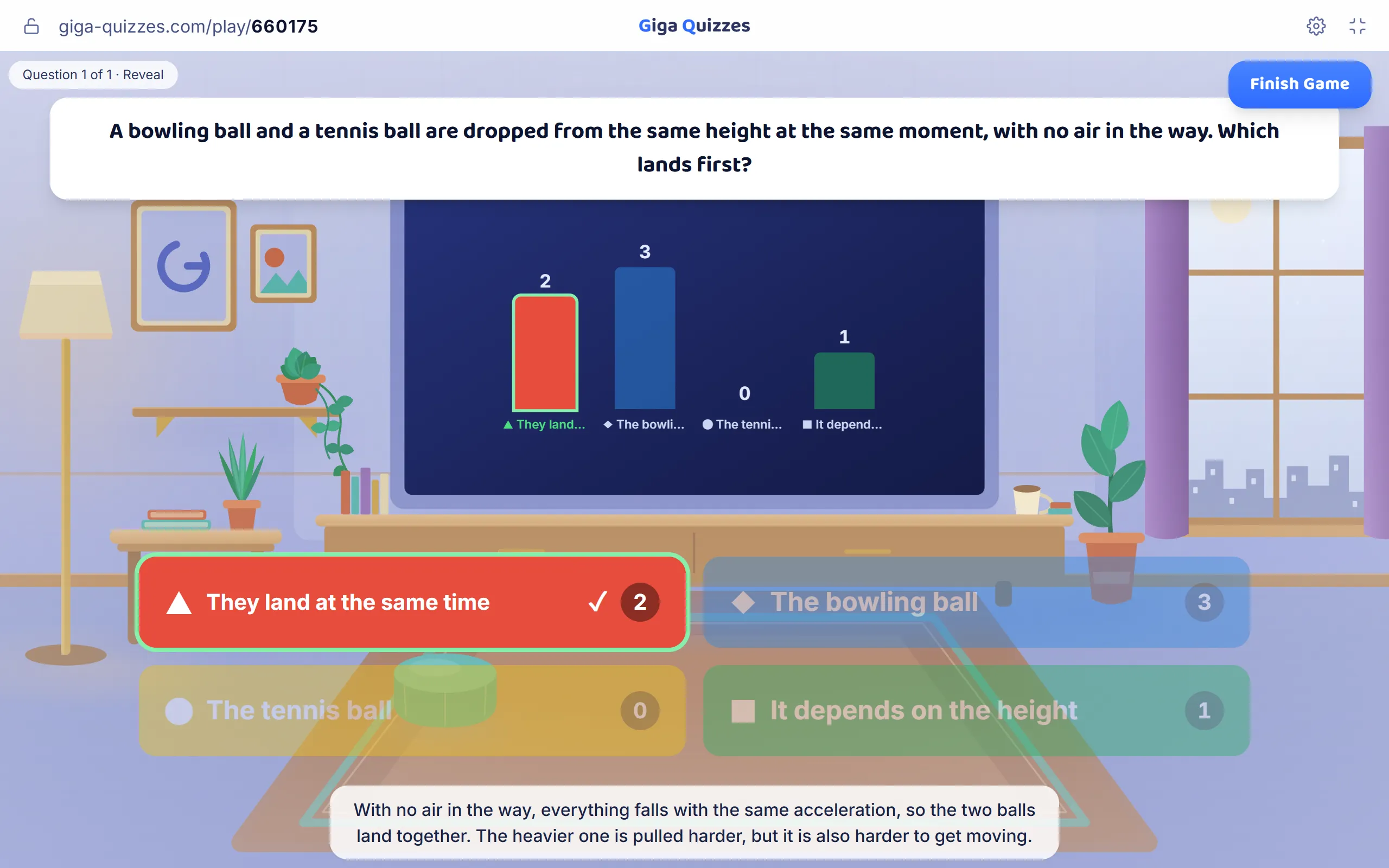
Wrong answers that cluster are the most valuable thing on the screen. If most of the room believes heavier objects fall faster, you know where the lesson needs to push hardest, before you start rather than after the test.
Writing a good pre-test
Keep it short, five to eight questions, and aim every question at a core idea of the topic, not a detail. The best pre-test questions are the ones you most want students to answer correctly at the end. Include at least one that targets a common misconception, because those are the beliefs the lesson has to change.
Example: a five-question pre-test on forces
- A bowling ball and a tennis ball are dropped together, with no air in the way. Which lands first? (Both together. It targets “heavier falls faster”.)
- A ball rolls across a perfectly smooth floor. Does it need a force to keep it moving? (No. It targets “motion needs a push”.)
- When you push against a wall, does the wall push back on you? (Yes, just as hard.)
- Is there gravity on the International Space Station? (Yes, about nine-tenths of what we feel on the ground. Astronauts float because they are falling around the Earth.)
- A book slides across a table and stops. What stopped it? (Friction.)
Multiple choice and true or false suit a pre-test, because students can make a reasonable guess without vocabulary they have not learned yet. A poll is useful too: “How much do you already know about forces?” has no right answer, but it tells you how confident the room feels.
Keep the stakes at zero
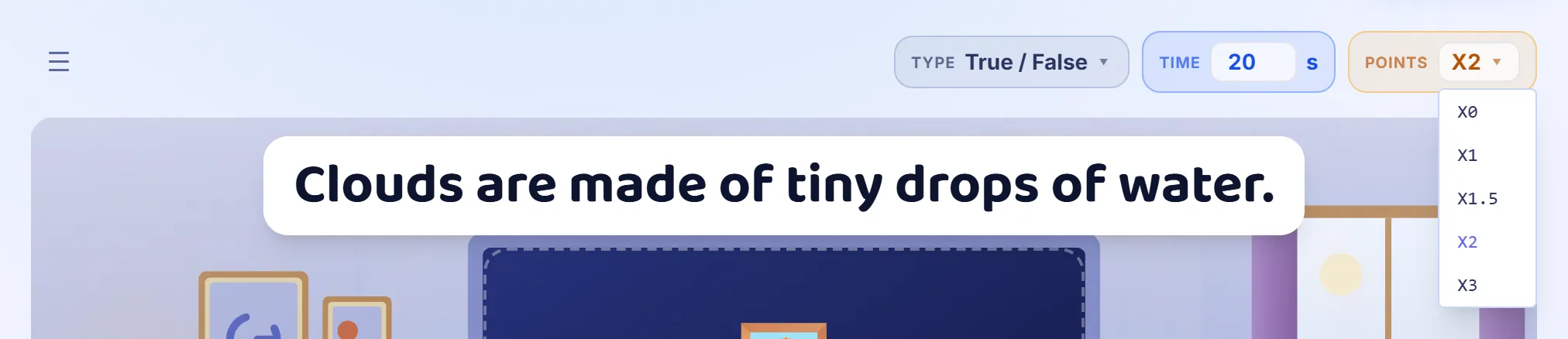
A pre-test should feel like a puzzle, not an exam. Say plainly that nobody is expected to know the answers yet and that you want to see what they think. Then take the score away, so that students guess honestly instead of freezing. In Giga Quizzes, the Points setting above each question goes from ×0 to ×3; set every pre-test question to ×0. The class still answers against the clock and sees the right answer at each reveal, but nobody wins and nobody falls behind.
Keep the reveals short. The lesson itself is the explanation, so there is no need to teach each answer on the spot. A sentence like “hold on to that, we will find out today” is often enough, and it leaves the question open in students’ minds, which is exactly where you want it.
Run it again at the end
The pre-test becomes even more useful when the same questions come back at the end of the topic. The difference between the two attempts shows, question by question, what the class learned. It is motivating for students too: a question most of them got wrong at the start and nearly all of them get right at the end is progress they can see.
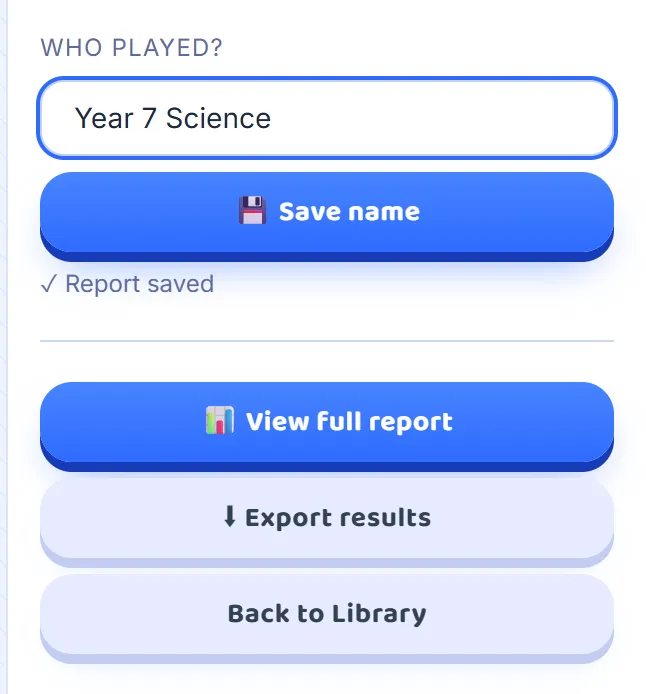
To compare the two games, name each one on the podium screen when it ends: type something like “7B, before” under Who played? and press Save name, and “7B, after” the second time. Both stay under Reports, and the question breakdown in each export lists the questions from best answered to worst, so you can see which ones moved.
Questions teachers ask
- Won’t getting most answers wrong put students off? Not if you say in advance that you expect it. Most classes enjoy a pre-test once they see it does not count.
- How long before the lesson should it be? Straight before is ideal, or at the end of the previous lesson. What matters is that the teaching follows soon after.
- Should I explain every answer at the reveal? No. Let the lesson answer the questions; that is where the benefit comes from.
- Does it work in every subject? It suits anything with facts and ideas to learn: science, history, geography, vocabulary in a new language.
Sources
- Richland, L. E., Kornell, N. & Kao, L. S. (2009). The pretesting effect: Do unsuccessful retrieval attempts enhance learning?. Journal of Experimental Psychology: Applied, 15(3), 243–257.
- Pan, S. C. & Carpenter, S. K. (2023). Prequestioning and pretesting effects: A review of empirical research, theoretical perspectives, and implications for educational practice. Educational Psychology Review, 35, article 97.
Try it in Giga Quizzes
Free, in the browser, and nothing for your students to install. These guides show each step on the real screens.
New to Giga Quizzes?
Free live quizzes in the browser. Students join from any phone, with no app.
Make your first quiz →