Teams or Solo: Which Quiz Format Fits Your Class?
A team quiz suits a class that already works in groups; a solo game shows where each student stands. What makes a team game work, how to keep teams fair, and when to choose each.
 By the Giga Quizzes team4 min read

In this post
The same quiz feels completely different played in teams and played alone. In a team game every right answer helps the people around you, and the quiet student who knows the answer becomes the hero of their table. In a solo game every student sees exactly where they stand. Both are useful. The trick is to match the format to the way your class already works, and to set teams up so that everyone in them still has to think.
The short answer
| Choose teams when… | Choose solo when… |
|---|---|
| The class already sits and works in groups | Each student needs an honest picture before a test |
| You want the weaker students to feel part of a win | The class is small, so teams would be two or three people |
| The aim is energy, mixing or celebration | Students are motivated by beating their own best |
| The material is review rather than brand new | You want to see each student’s answers without the noise of a table |
What makes a team game work
Putting students into teams does not automatically make them work together. Decades of research on cooperative learning, summarised by David and Roger Johnson, point to two conditions that matter most. The first is positive interdependence: students need each other to succeed, so helping a teammate helps you. The second is individual accountability: each person’s own contribution still counts and can be seen, so nobody can hide behind the group.
A well-run quiz team has both built in. When a team’s score is every member’s points added together, each right answer helps the whole table, and a student near the bottom of the class can carry their team on a good day. When every student still answers on their own device, nobody can let the strongest player answer for them, and the report afterwards keeps each student’s own answers. The team celebrates together, but you still know who knew what.
For classes that already work in groups
Teams make the most sense where the groups already exist. If your class sits in fixed tables, with each group working on its own task during the lesson, a team quiz fits in naturally: the groups are already formed, students know who they are working with, and the quiz simply gives each group a score. Use the names the groups already have, or the table numbers, and the game becomes part of how the class runs rather than a break from it.
It works particularly well at the end of a lesson where each group spent its time on something different, such as stations or a research task. A short team quiz covering every group’s topic gives each table a reason to listen to what the others found, and gives the experts on each table a moment to shine.
Keep the teams fair
- Same size. A team’s score is the sum of its players, so a team with more players has more chances to score. Move a student or two across before you start.
- Mixed ability. Groups the class already uses are usually mixed on purpose, another reason they make good quiz teams.
- Late arrivals go where they are needed. A student who joins after the start should land in the smallest team, not the one their friends are in.
- Not too many teams. Four to six teams of four to six students keep the leaderboard readable and every team in the race.
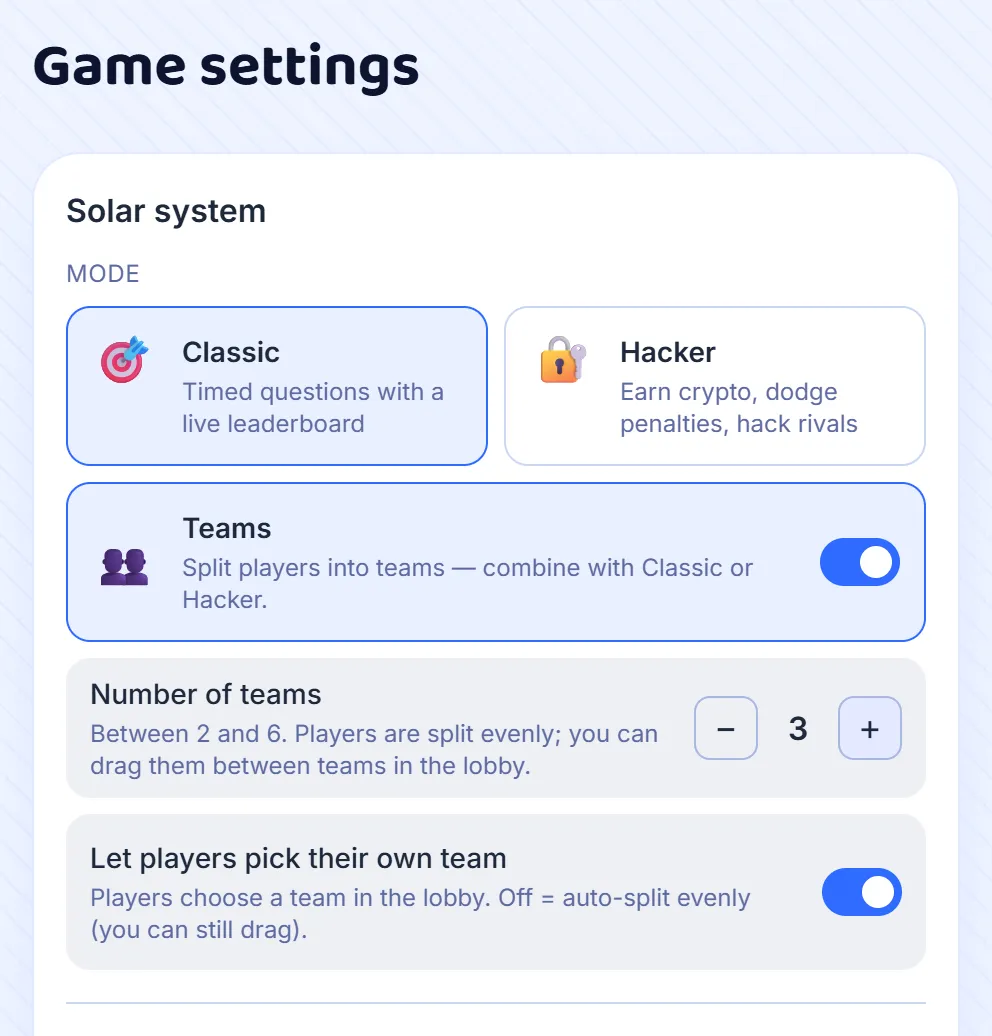
In Giga Quizzes, switch on Teams in Game settings and choose between two and six. The game can share students out evenly as they join, or Let players pick their own team lets each student tap a team in the lobby, where you can still drag names between columns to match the groups sitting in your room. Anyone who has not chosen by the start, or who joins later, goes into the team with the fewest players.
What each student sees
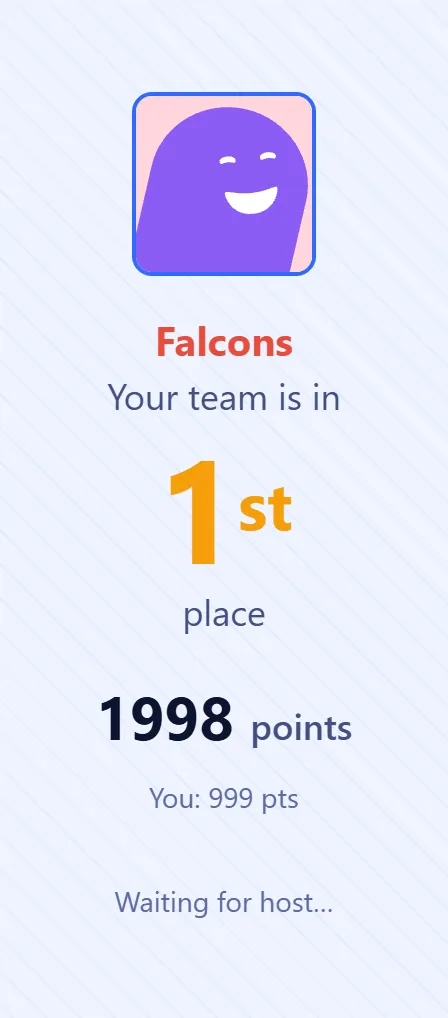
A worry about teams is that students lose track of their own part. On each phone the leaderboard shows the team standings, with the student’s own team marked and, underneath, their own place among all the players. Students see what the team is doing and what they are adding to it.
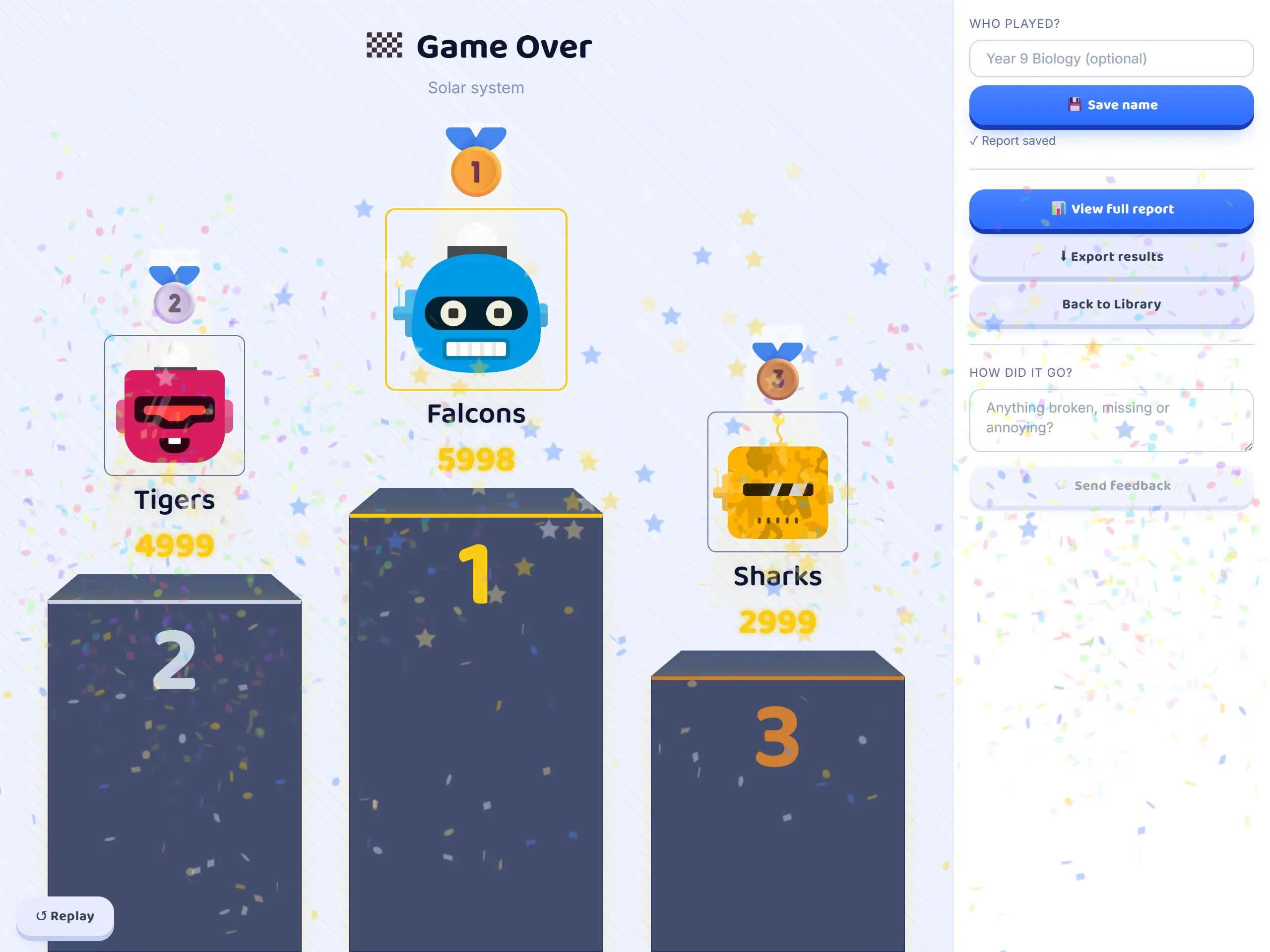
The game ends on a team podium, which suits a class better than a single winner: a quarter of the room celebrates instead of one student.
When solo is the better choice
Before a test, play alone. Students need to know honestly what they can do without their table, and you need to see it too. A solo game is also better with a small class, where teams of two feel thin, and with a class that does not normally work in groups, where teams would be invented for the occasion and mean little.
Some classes simply prefer it. Students who like to measure themselves against their own last score often find a team game frustrating, especially if they are carrying a team. Watch how your class responds to each format; most groups make it clear quite quickly which one brings out their best.
Teams in a self-paced game
Teams also work when every student plays at their own speed. In Hacker mode, each right answer earns crypto from a vault, and with teams switched on each team’s crypto is added up. It suits a long practice session in a class that works in groups: everyone is busy for the whole game, nobody waits for anyone, and every right answer feeds the team.
Sources
- Johnson, D. W. & Johnson, R. T. (2009). An educational psychology success story: Social interdependence theory and cooperative learning. Educational Researcher, 38(5), 365–379.
Try it in Giga Quizzes
Free, in the browser, and nothing for your students to install. These guides show each step on the real screens.
New to Giga Quizzes?
Free live quizzes in the browser. Students join from any phone, with no app.
Make your first quiz →