Reading Quiz Results: What to Reteach Tomorrow
A quiz report holds the plan for your next lesson. Which question to look at first, why the wrong answers matter more than the scores, a worked example, and how to read a self-paced game.
 By the Giga Quizzes team4 min read

In this post
When a quiz ends, the room is looking at the podium. The more useful picture arrives a minute later, in the results. A good report tells you which ideas landed, which did not, and why, and that is tomorrow’s lesson plan. It takes about five minutes to read, once you know where to look and what to ignore.
Why five minutes with the results pays off
A quiz is only half of what researchers call formative assessment. The other half is doing something different because of what it showed. In their influential review, Paul Black and Dylan Wiliam brought together the research on classroom assessment and concluded that using evidence of what students understand to adjust teaching, day by day, produces real gains in learning, often largest for the students who were struggling most.
The key word is adjust. A quiz you mark and file changes nothing. A quiz whose hardest question becomes the first five minutes of the next lesson does.
Three questions to ask of any result
- Which questions did the class find hard? That tells you what to teach again.
- Which wrong answers did they choose? That tells you why they found it hard.
- Which students are struggling across the board? That tells you who needs help.
The class average is not on the list. An average of 70 per cent can hide one topic everyone understood and one nobody did, and it is the second topic you need to know about.
Start at the bottom of the breakdown
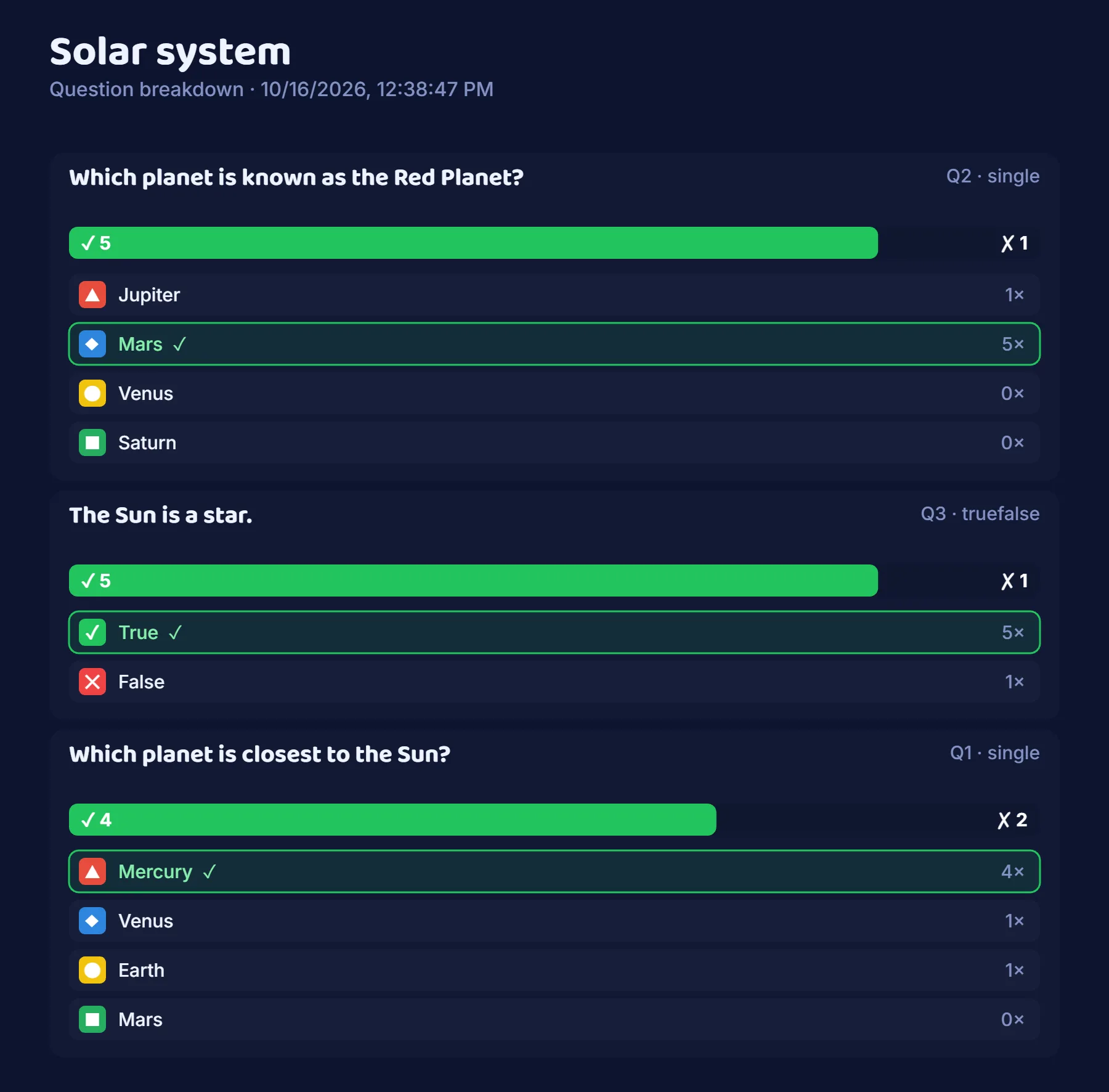
In Giga Quizzes, Export results on the podium screen downloads a set of pictures. One is the question breakdown: every question, how many students got it right, and how many chose each answer, with the right one marked. It is ordered from the best answered question to the worst, so the question at the bottom is where tomorrow starts.
A worked example
Here is a five-question exit quiz on fractions, as a breakdown might show it, and what each line says.
| Question | Right | Most common wrong answer | What it tells you |
|---|---|---|---|
| Shade 3/4 of a shape | 27 of 28 | — | Secure. Do not spend time here. |
| Which is bigger, 1/3 or 1/4? | 15 of 28 | 1/4 (11 students) | A shared belief: bigger denominator, bigger fraction. |
| Simplify 6/8 | 21 of 28 | Spread over three answers | A few students are still guessing; check them individually. |
| 1/2 + 1/4 | 12 of 28 | 2/6 (14 students) | The same students add the tops and the bottoms. |
| Order 1/2, 1/5, 1/3 | 13 of 28 | Ordered by denominator | The same belief as question two, showing up again. |
The scores alone would say “fractions are a bit weak”. The wrong answers say something far more useful: about twelve students believe a larger number on the bottom means a larger fraction, and some of them add fractions by adding tops and bottoms. That is two specific ideas to teach tomorrow, not a whole topic to repeat.
Is it the idea, or the question?
Before deciding the class did not understand, check that the question was fair. A confusing question looks exactly like a hard idea in a report. Read the bottom question again with fresh eyes and ask:
- Could a student who knows the idea still misread it?
- Was the timer long enough for the amount of reading or dragging?
- Was a wrong answer arguably right?
- Did the question depend on a word students had not met?
If any answer is yes, fix the question and ask it again before you reteach anything. It may turn out the class knew it all along.
Each student, and the pattern over time
The same export includes a result card for each player: their place and score, how many they got right, and every question with the answer they gave and a tick or a cross. The full report, under Reports, shows every player’s answers question by question.
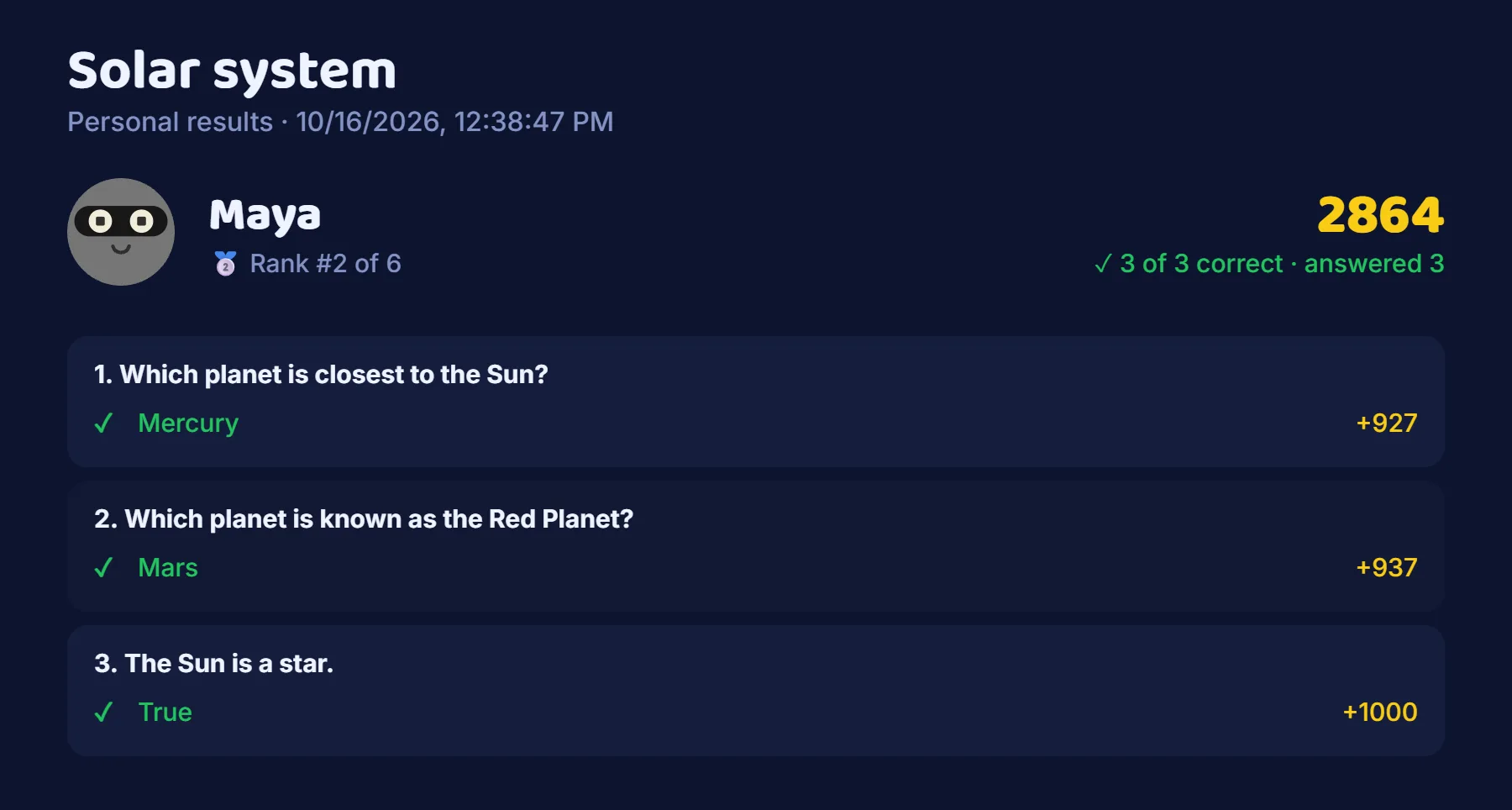
Be careful about reading too much into one game. A student who scored low may have joined late, been distracted, or simply had a bad day. Patterns over several games are far more reliable than any single result, which is why it helps to name each game as it ends, with the class and the topic, so a month later you can line them up.
Reading a self-paced game
In Hacker mode, the final standings partly reflect luck in the vaults, so crypto is not a measure of knowledge. Read accuracy instead, the share of a student’s answers that were right, and sort by it.
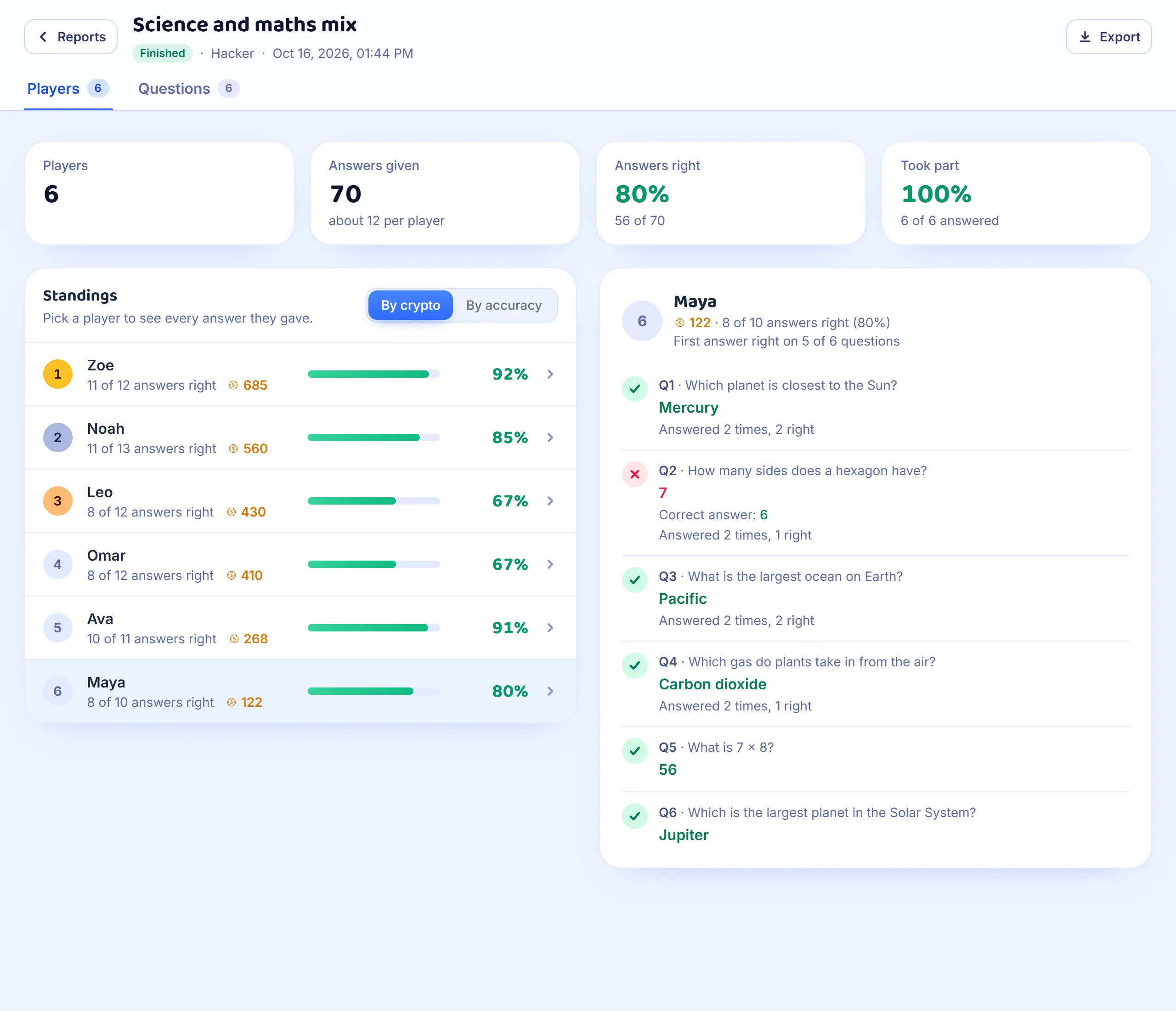
Because the questions come round again, a student’s row also shows learning during the game. A question missed the first time and answered right every time after is a small success story. A question missed every time is a gap the game could not close on its own, and those are the ones to take to tomorrow.
From results to tomorrow’s lesson
- Pick the one or two questions at the bottom of the breakdown.
- Read the most common wrong answer on each and name the belief behind it.
- Open the next lesson by asking that question again, before teaching anything.
- Teach the idea a different way from the first time, aimed at the belief.
- End the lesson with a similar, new question to see whether it worked.
Sources
- Black, P. & Wiliam, D. (1998). Assessment and classroom learning. Assessment in Education: Principles, Policy & Practice, 5(1), 7–74.
Try it in Giga Quizzes
Free, in the browser, and nothing for your students to install. These guides show each step on the real screens.
New to Giga Quizzes?
Free live quizzes in the browser. Students join from any phone, with no app.
Make your first quiz →