Review for an Exam in One Lesson
A plan for a single review lesson before a test: why a quiz beats rereading notes, a short slide for each topic, questions built on common mistakes, and practice at home afterwards.
 By the Giga Quizzes team4 min read
In this post
The lesson before a test is precious. Students are finally thinking about the whole unit at once, and you have one chance to bring it all back, find out what is still shaky, and send them home knowing what to revise. A well-built quiz can do all three in a single lesson, as long as it is more than a string of questions. The secret is to put a short summary before each topic, so the game reminds as it tests, and to read the results before the bell.
Why a quiz beats rereading the notes
Left to themselves, most students revise by rereading and highlighting. It feels productive, because the material looks more and more familiar, but familiarity is not the same as being able to recall it in an exam hall. When John Dunlosky and colleagues reviewed the evidence on ten common study techniques, rereading and highlighting came out as low utility. Practice testing, answering questions from memory, was one of only two techniques rated high utility, with benefits across ages, subjects and kinds of test.
A review quiz is practice testing with a scoreboard. Every question makes students pull an idea out of memory, which is what strengthens it, and every wrong answer shows them, and you, exactly where the gaps are while there is still time to fill them.
Ten minutes of planning
Write down the topics the test will cover. Most units come down to five or six. For each one, note what a student must know and the mistake students most often make. That short grid becomes the whole plan for the lesson.
| Topic | Must know | The usual mistake |
|---|---|---|
| Cells | Plant cells have a wall and chloroplasts | Thinking only animal cells have a nucleus |
| Microscopes | How to work out magnification | Adding the lens powers instead of multiplying |
| Diffusion | Particles spread from high to low concentration | Thinking diffusion needs energy |
| Organs | Cells form tissues, tissues form organs | Getting the order of levels backwards |
| Respiration | Mitochondria release energy from glucose | Confusing respiration with breathing |
A slide before every topic
Before the questions on each topic, put a short summary slide that brings it back to mind. Three or four bullet points, short enough to read aloud in twenty seconds, are enough. A diagram from the unit works just as well, shown big.
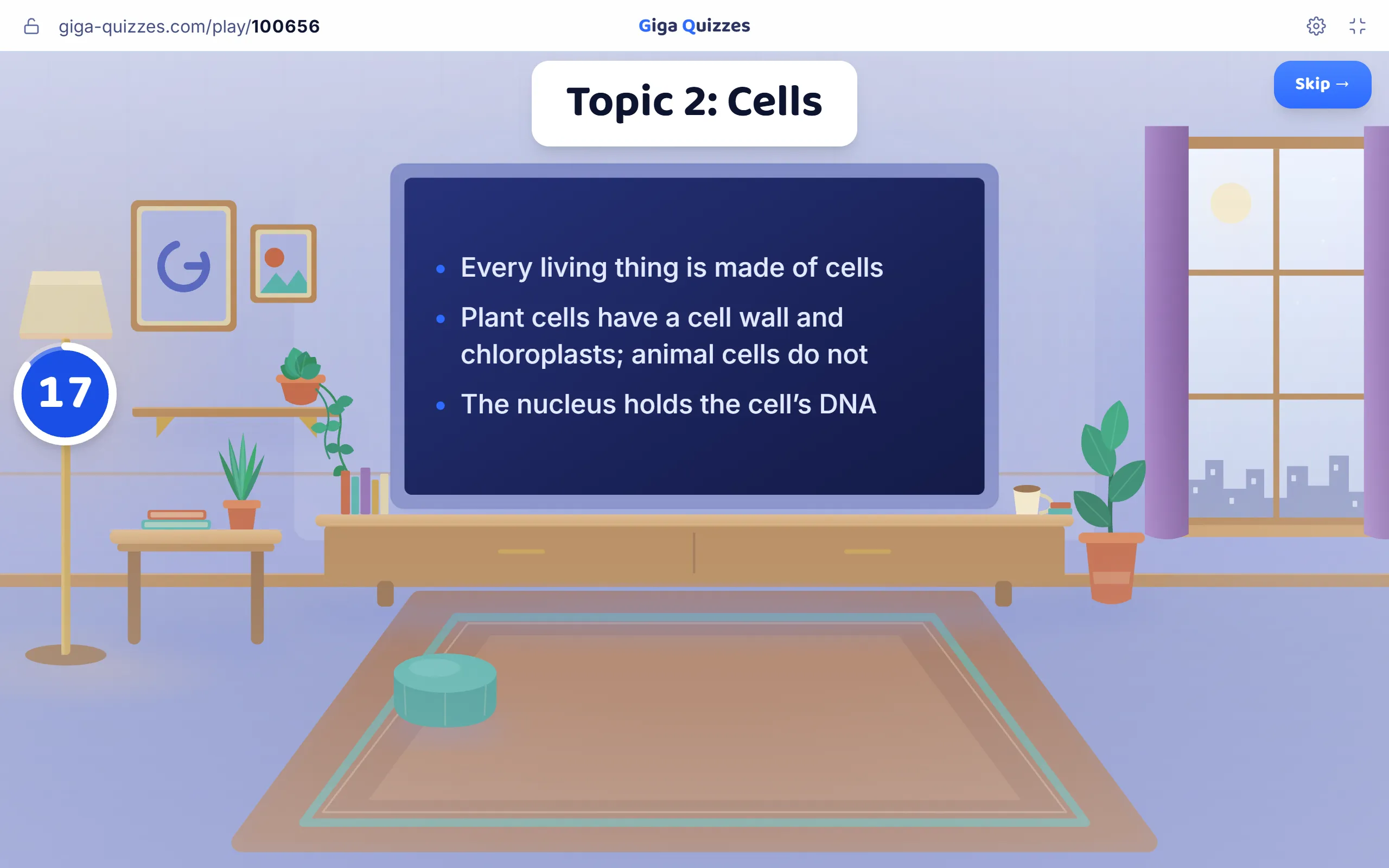
The slides do two jobs. They remind students of the material just before they are asked about it, which lifts the weaker students into the game, and they break a long quiz into chapters, so twenty questions do not feel like twenty questions. In Giga Quizzes these are Information slides: no answers and no points, with a choice of layouts including Bullet points, where each line you type becomes its own point, and Big image for a diagram. While a slide is up, every phone tells students to look at the board.
Then two or three questions
After each slide, ask two or three questions on that topic. Aim them at the must-know ideas rather than the details, and put the usual mistake from your grid in as a wrong answer in at least one of them. Mix the formats: a single choice, a typed answer for a key term, an ordering question for a process.
Fill in an explanation for every question. In a review lesson, it is the most valuable line in the quiz: a student who gets it wrong reads why straight away, on the board and on their own phone, the day before it matters.
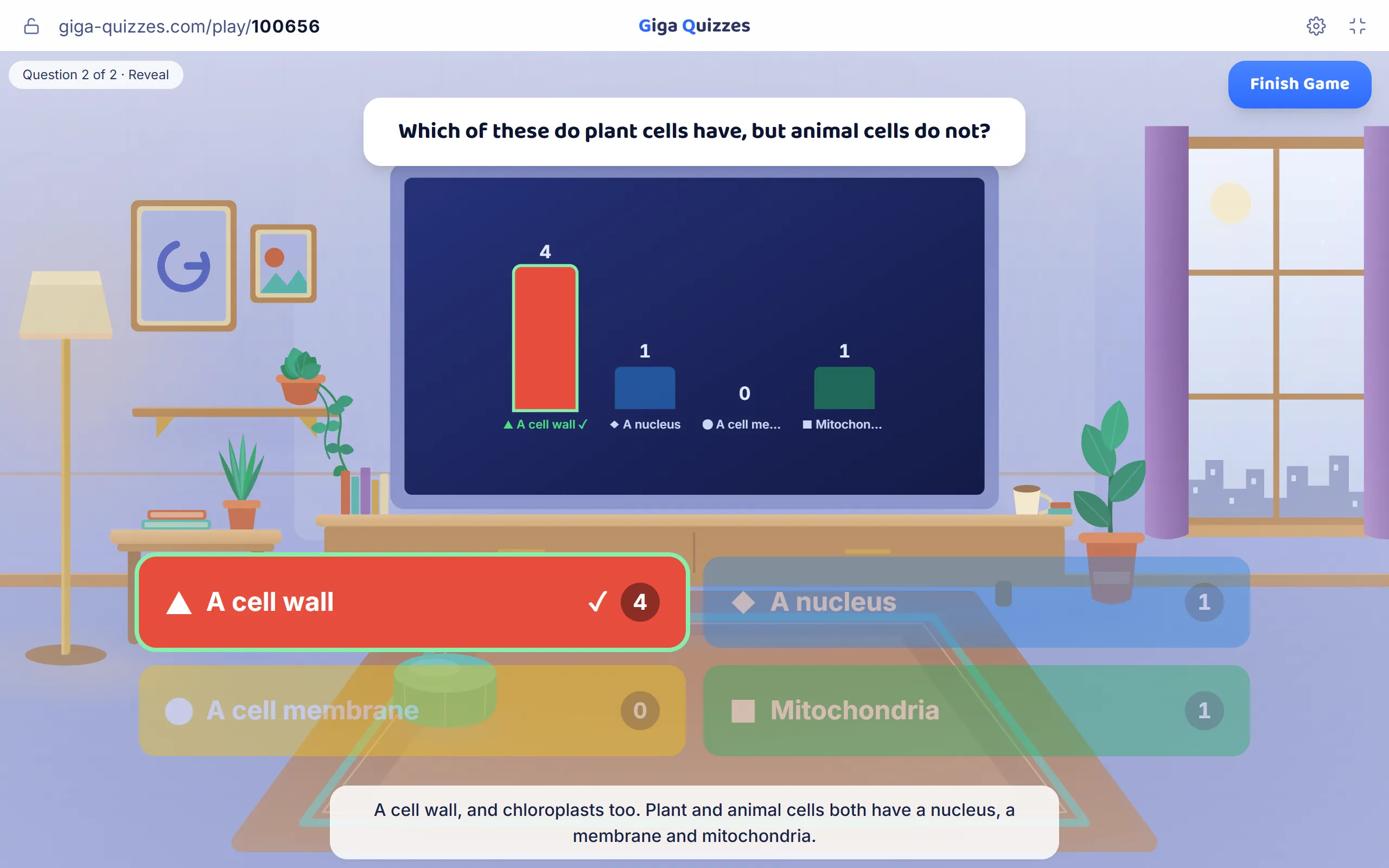
Switch off Auto-advance screens before the lesson, so each reveal waits for you. When the chart shows a topic the class has not mastered, stop and teach it again for two minutes. When everyone got it, move straight on.
The lesson, minute by minute
| Minutes | What happens |
|---|---|
| 0–5 | Explain the plan; everyone joins the game |
| 5–35 | Six topics: a slide, then two or three questions each, stopping where the chart shows a gap |
| 35–42 | Look at the results together and name the two or three topics to revise tonight |
| 42–50 | If time allows, a fast self-paced round on the same set, with the questions coming round again |
Read the results before the bell
The results tell students what to revise and tell you what to reteach. Export them at the end of the game and you get a breakdown of every question, ordered from the one most students got right to the one the fewest did. The questions at the bottom are tonight’s revision list, and the most common wrong answer on each tells you what the misunderstanding is.
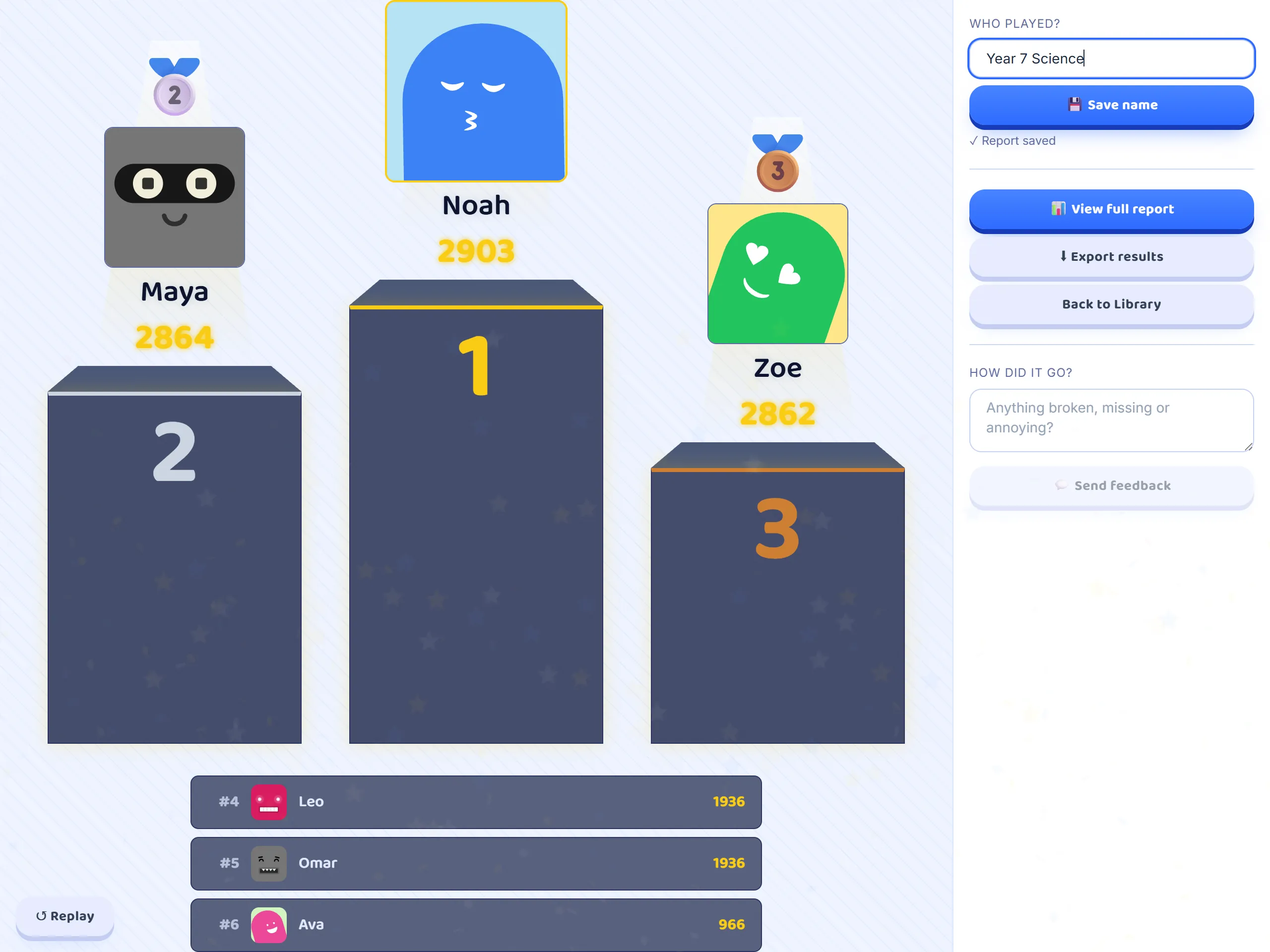
Read the bottom three out to the class. “These are the three things to look at tonight” is far more useful revision advice than “go over everything”.
Practice at home
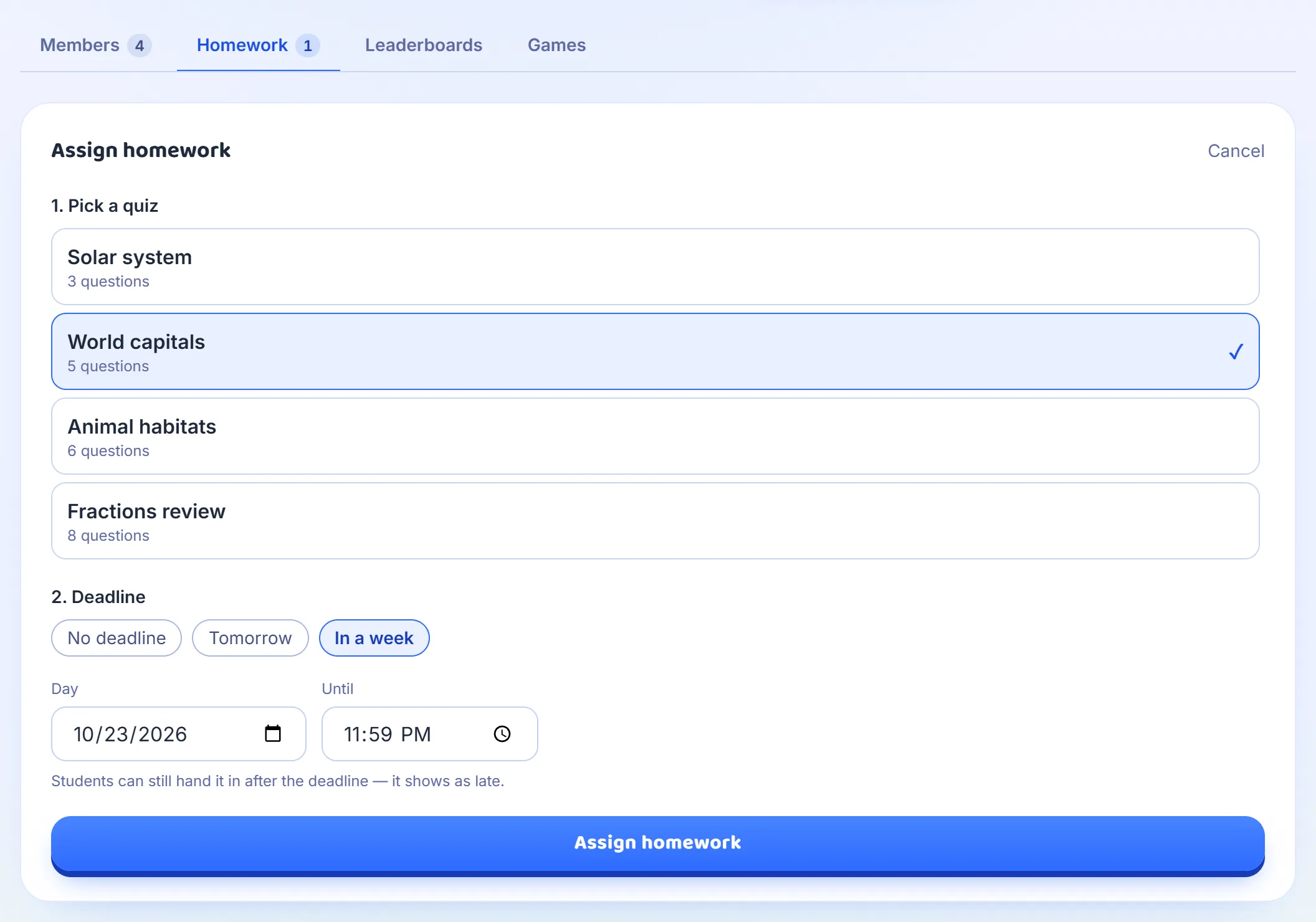
A review lesson works best when students can go through the same material again before the test. If your class has a group, set the same quiz as homework with a deadline the evening before. Students play it alone, at their own pace, and see the same slides and explanations they saw in class. They can play it more than once, and their best score counts.
Questions teachers ask
- How many questions? Twelve to eighteen, plus the slides. Longer than an everyday quiz, but the slides and the stops keep it moving.
- Should it count towards a grade? No. Students take more risks, and tell you more, when the review is practice.
- What if the class does badly? Better to find out today than in the exam. Reteach the bottom topic briefly and send the quiz home.
- Teams or solo? Solo, if you can. Each student needs an honest picture of what they can do alone.
Sources
- Dunlosky, J., Rawson, K. A., Marsh, E. J., Nathan, M. J. & Willingham, D. T. (2013). Improving students’ learning with effective learning techniques: Promising directions from cognitive and educational psychology. Psychological Science in the Public Interest, 14(1), 4–58.
Try it in Giga Quizzes
Free, in the browser, and nothing for your students to install. These guides show each step on the real screens.
New to Giga Quizzes?
Free live quizzes in the browser. Students join from any phone, with no app.
Make your first quiz →