How Long Should a Classroom Quiz Be?
Five minutes, fifteen, or a whole lesson? It depends on what the quiz is for and how it is played. The real time a question takes, what the attention research says, and a quick reference.
 By the Giga Quizzes team4 min read

In this post
There is no single right length for a quiz. A warm-up that runs for twenty minutes eats the lesson it was meant to start, and a review of a whole unit squeezed into five questions misses most of it. The right length depends on two things: the job the quiz has to do, and the way it is played. A ten-question live game and a ten-question self-paced race take completely different amounts of time. Here is how to plan for both.
Start from the job
Most quizzes that drag do so because they are trying to do two jobs at once. Decide which one this quiz is for before counting questions.
| The job | Questions | Minutes | What it tells you |
|---|---|---|---|
| Opener | 4–6 | About 5 | Whether last lesson stuck |
| Check in the middle of a lesson | 3–5 | 3–5 | Whether to move on |
| Exit quiz | 3–5 | 5–8 | What to fix tomorrow |
| Review before a test | 12–20 | 20–30 | Which topics need revising |
| Practice and drilling | 10–15, repeated | 10–40 | Who has it, and who is getting there |
A question takes longer than its timer
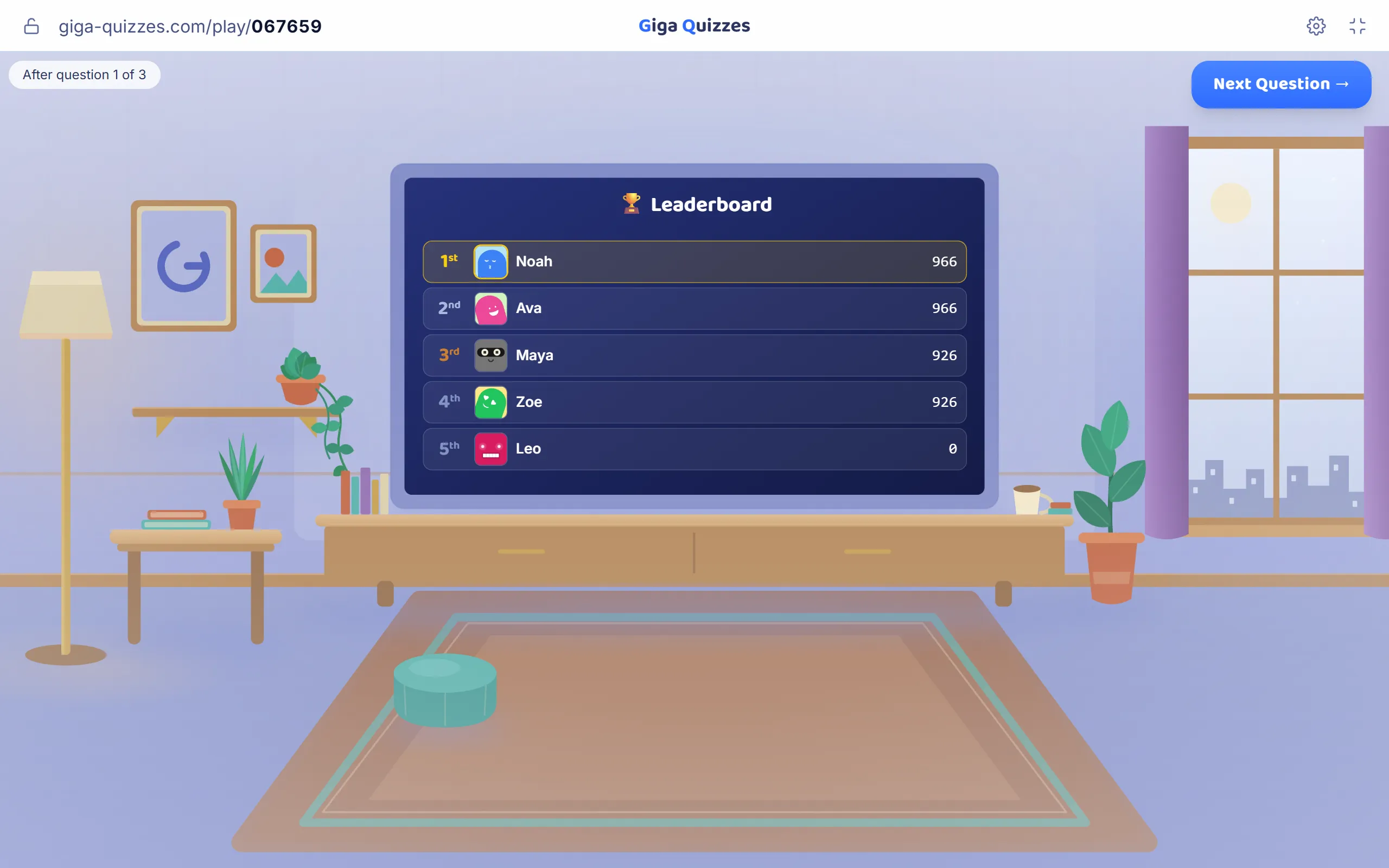
In a classic live game, everyone answers the same question at the same time, then sees the answer and the leaderboard together. The timer is only part of it. A typical twenty-second question really runs like this:
- A few seconds for the question to appear and be read.
- Up to twenty seconds of answering, often less if everyone answers early.
- Ten seconds or so on the reveal, longer if you stop to explain.
- A few more on the leaderboard between questions.
That makes roughly forty-five seconds to a minute per question, and more for any reveal you talk through, which you often should. Ten questions take about ten minutes; fifteen take about fifteen. Plan from that figure, not from the sum of the timers.
What about attention spans?
You will often read that students can only concentrate for ten or fifteen minutes. The evidence for a fixed number is weaker than its popularity suggests. Reviewing the studies behind the claim, Neil Bradbury found that many were small, measured attention indirectly, and did not agree with one another, and that attention depends heavily on what is going on in the room and who is teaching.
For a quiz, that is useful news. There is no clock inside students that runs out at minute twelve; what runs out is variety and the feeling that the game is still winnable. So rather than a rule, watch the room, and use the signs below.
Classic games: ten to fifteen questions
For a live game where the class moves together, ten to fifteen questions and about fifteen minutes is the sweet spot. Beyond that the students near the bottom of the leaderboard stop believing they can catch up, and once they stop trying, the game is only for the top five.
If you have more material than that, split it. One game now and another after the next activity keeps everyone in it; one long game keeps only the leaders in it. A slide halfway through, recapping the first part, also breaks a longer quiz into two halves that each feel short.
Hacker mode: a whole lesson
A self-paced game changes the answer completely. In Giga Quizzes’ Hacker mode, nobody waits for the next question: every student answers at their own speed on their own phone, a right answer opens a vault that pays, multiplies or hacks, and the set loops back to the first question once a student finishes it. The length is set by the clock, anything from one to sixty minutes, or by a crypto target that ends the game when someone reaches it.
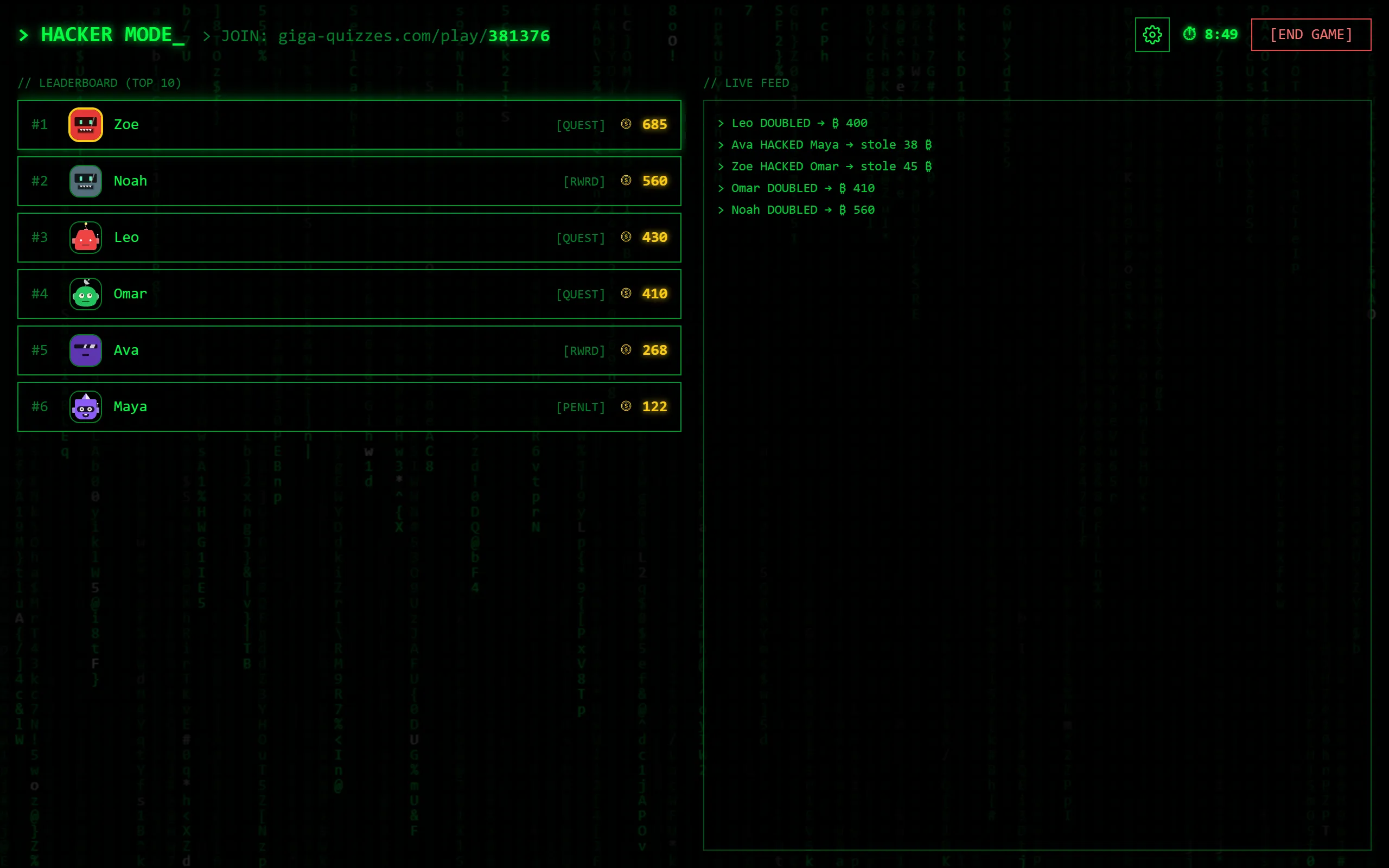
Because the questions come round again, ten to fifteen good questions can carry thirty or forty minutes of practice, a full lesson. The repetition is the point. By the third time a question comes round, most of the students who missed it the first time have learned it, which makes this format ideal for vocabulary, times tables, formulas and key facts, and less suited to questions that need discussion.
Signs a quiz is too long
- Fewer answers come in towards the end.
- Answers arrive in the first second or two: guessing, not thinking.
- Students at the bottom of the leaderboard put their phones down before the last question.
- You start skipping your own explanations to get through the rest.
If you see two of these, cut the next quiz by a third. A quiz that ends while the class still wants one more question beats one that ends because everyone has had enough.
A five-minute opener, step by step
- Four questions on last lesson’s topic, mostly true or false and single choice.
- Timers of fifteen to twenty seconds.
- One question that leads into today’s topic.
- One fun question at the end, about anything at all.
Set every question to no points if you want nobody to start the lesson behind. The class still answers and still sees the reveals, which is where the reviewing happens.
Sources
- Bradbury, N. A. (2016). Attention span during lectures: 8 seconds, 10 minutes, or more?. Advances in Physiology Education, 40(4), 509–513.
Try it in Giga Quizzes
Free, in the browser, and nothing for your students to install. These guides show each step on the real screens.
New to Giga Quizzes?
Free live quizzes in the browser. Students join from any phone, with no app.
Make your first quiz →