The Last 10 Minutes of Class
The end of a lesson is often lost to packing up. A three-question exit quiz and a confidence poll show what the class learned, and what it only thinks it learned.
 By the Giga Quizzes team4 min read

In this post
The last ten minutes of a lesson have a habit of disappearing. An activity runs over, bags come out early, and the bell goes before anyone has asked whether the lesson worked. Those minutes are worth protecting. A short exit quiz tells you, in about five minutes, what the class learned today, and, paired with one honest poll, what it only thinks it learned. That is exactly what you need to plan tomorrow.
Why end with a quiz
Teachers have used exit tickets for a long time: a question or two on a slip of paper, handed in at the door. They work, but they leave you with thirty slips to read tonight. A live exit quiz does the same job and shows the results on the spot.
It also does something for the students. Answering a question about what they have just learned makes them pull it back out of memory, and that act of recall is one of the most reliable ways to make learning last. Pooja Agarwal, Ludmila Nunes and Janell Blunt reviewed classroom experiments on this “retrieval practice” in real schools, across ages and subjects, and found it improved learning in the large majority of them.
Three questions, all on today
An exit quiz is short and focused. Every question is about today’s main idea, not a review of the unit.
The exit quiz recipe
- One question on the key fact or term, to check the basics landed.
- One question that applies the idea to a new example, a short problem or a “what would happen if”.
- One question built on the most common mistake, with that mistake as one of the wrong answers.
- Then one poll: “How well do you understand today’s topic?”
Twenty seconds per question and a quick look at each reveal brings the whole thing to about five minutes, which leaves room for a sentence or two on anything that went badly.
A worked example: photosynthesis
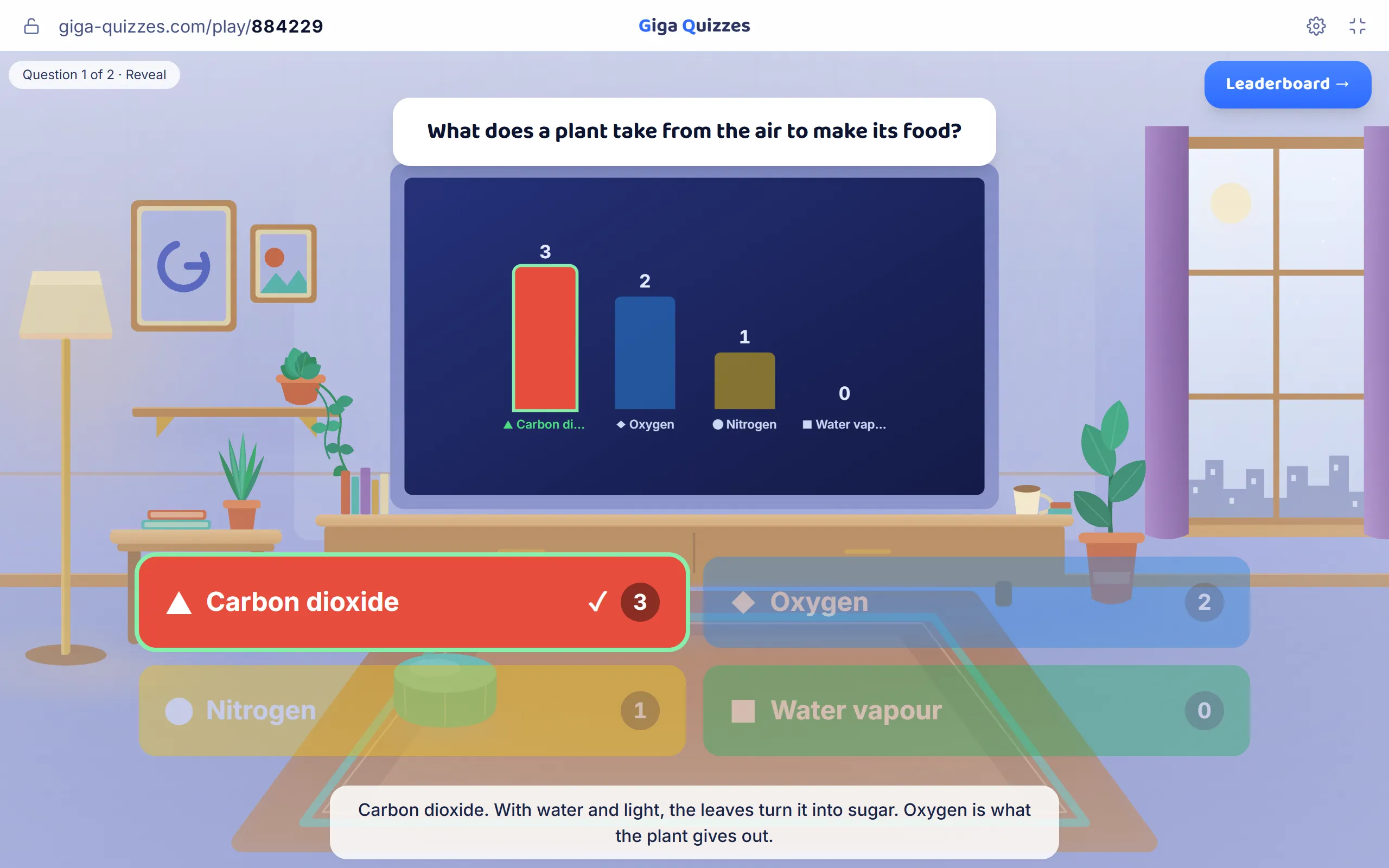
Here is the mistake question from an exit quiz after a lesson on photosynthesis: what does a plant take from the air to make its food? Half the class got it right. Two students chose oxygen, the classic mix-up between what plants take in and what they give out.
Then the poll: how well do you understand photosynthesis now? Five of the six students said they could explain it or mostly got it.
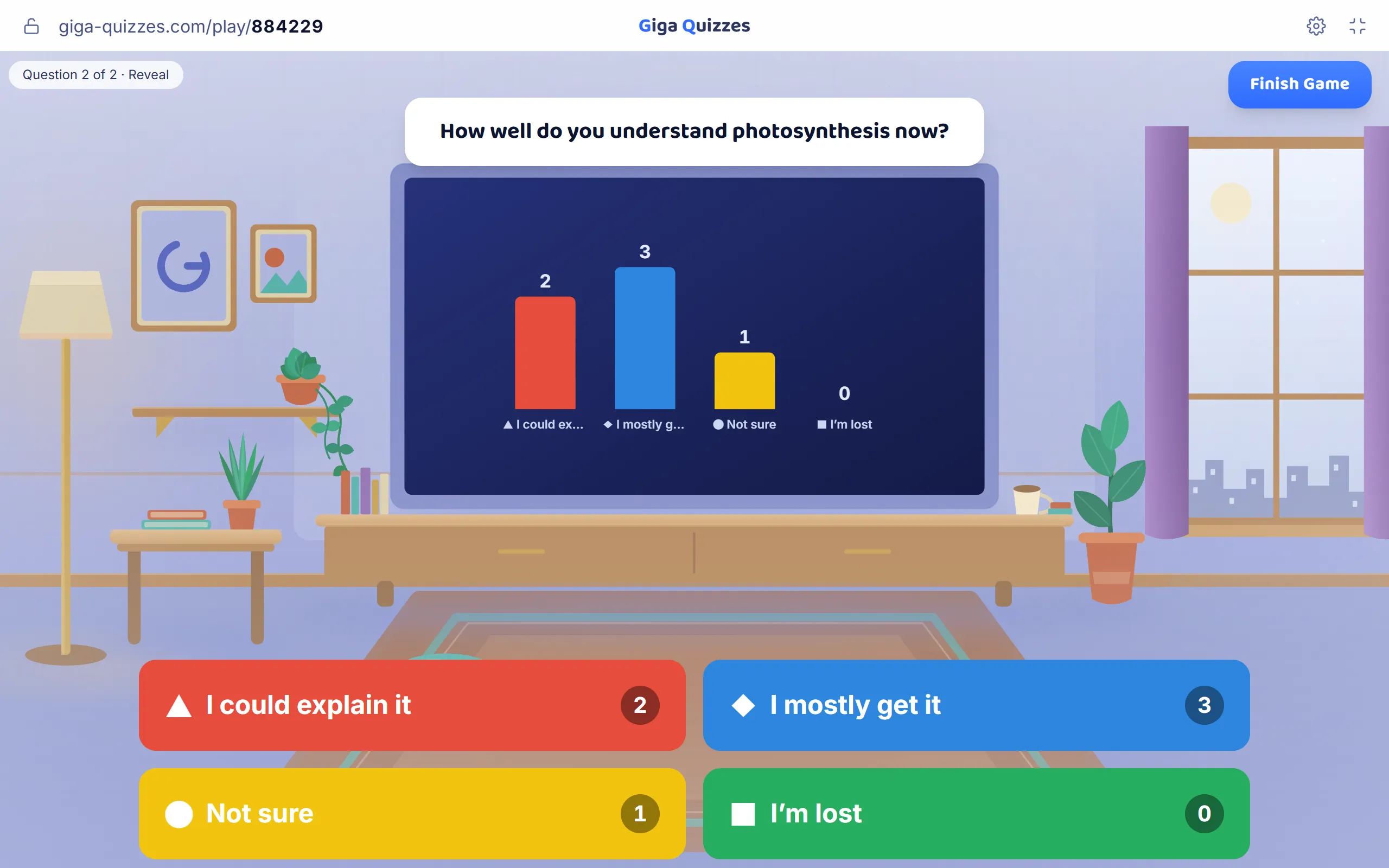
Put the two charts side by side and the real finding appears. The class is more confident than its answers. That is the most important thing an exit quiz can tell you, because a student who knows they are lost will ask for help, but a student who wrongly thinks they understand will not.
Reading confidence against answers
| Feels sure | Feels unsure | |
|---|---|---|
| Answered right | Learned. Move on tomorrow. | Learned, but needs reassurance and a little more practice. |
| Answered wrong | A confident misconception. Start tomorrow here. | Knows it is lost. Reteach, and check in with these students first. |
The poll works because nobody sees who chose what. Many students who would never say “I’m lost” out loud will tap it on a phone, and you get an honest map of the room in fifteen seconds.
Protect the ten minutes
The hardest part of an exit quiz is starting it on time, because something in the lesson always wants to run over. A few habits help:
- Set a timer on your phone for ten minutes before the bell, and stop whatever is happening when it goes.
- Build the exit quiz while you plan the lesson, from the same notes. It is three questions; it takes five minutes.
- Keep the game open in a browser tab from the start of the lesson, so it is one click away.
- Bags stay down until the podium. Say it once and it becomes the routine.
A one-line explanation under each question pays off here too. It appears at the reveal on the board and on every phone, so the students who got it wrong leave knowing why, even if there is no time to talk.
Plan tomorrow from the results
If you host while signed in to Giga Quizzes, the results are saved to your account. Name the game on the podium screen, so it is easy to find, and export the results for a breakdown of every question, from the best answered to the worst, plus a card for every student. The guide to what happens after the game shows each picture.
Tomorrow’s first five minutes write themselves. Ask the worst-answered question again, before teaching anything, and see whether a night’s sleep and a fresh explanation have moved the chart. For the photosynthesis class, that means one question about what plants take in and what they give out, and a minute with the two students who said oxygen.
Sources
- Agarwal, P. K., Nunes, L. D. & Blunt, J. R. (2021). Retrieval practice consistently benefits student learning: A systematic review of applied research in schools and classrooms. Educational Psychology Review, 33(4), 1409–1453.
Try it in Giga Quizzes
Free, in the browser, and nothing for your students to install. These guides show each step on the real screens.
New to Giga Quizzes?
Free live quizzes in the browser. Students join from any phone, with no app.
Make your first quiz →