What Actually Motivates Students in a Quiz
A race anyone can still win, a finish line a month away, more than one way to come first, and a team to play for. What keeps a whole class trying in a quiz game, and why.
 By the Giga Quizzes team5 min read
In this post
Start a quiz game and the room changes. Students who were slumped in their chairs sit up, and an argument breaks out over a question about fractions. That energy is real, but it fades fast if only three students have a chance of winning. By the fourth question, the student in twentieth place has quietly stopped trying. Keeping a whole class motivated, not just the leaders, comes down to a few ideas that psychologists have studied for decades and that are easy to build into a quiz.
Three things every student is looking for
Self-determination theory, developed by Richard Ryan and Edward Deci, is one of the most cited accounts of what drives people to put in effort. It names three basic needs: competence, the sense of being able to do something and getting better at it; autonomy, the sense of having some say; and relatedness, the sense of mattering to the people around you. Each one has a direct counterpart in a classroom quiz.
| Need | What it sounds like | Try this in a quiz |
|---|---|---|
| Competence | “I can get these right, and I am improving.” | Pitch most questions so most students can answer them, and show progress over time |
| Autonomy | “I have some choice here.” | Let the class pick the topic from a short list, or choose between two game formats |
| Relatedness | “My answers matter to someone.” | Play in teams, and celebrate what the class achieved together |
Notice what is missing from that list: being the very best. Winning is fun for the winner, but a game designed only around first place leaves the rest of the room with nothing to play for. The ideas below keep the race exciting while giving everyone a reason to keep answering.
A race where anyone can still win
In a classic quiz, the leaderboard after each question can settle the game early. A student five places behind after three questions knows the maths and stops caring. Formats where the lead keeps changing hands fix that.
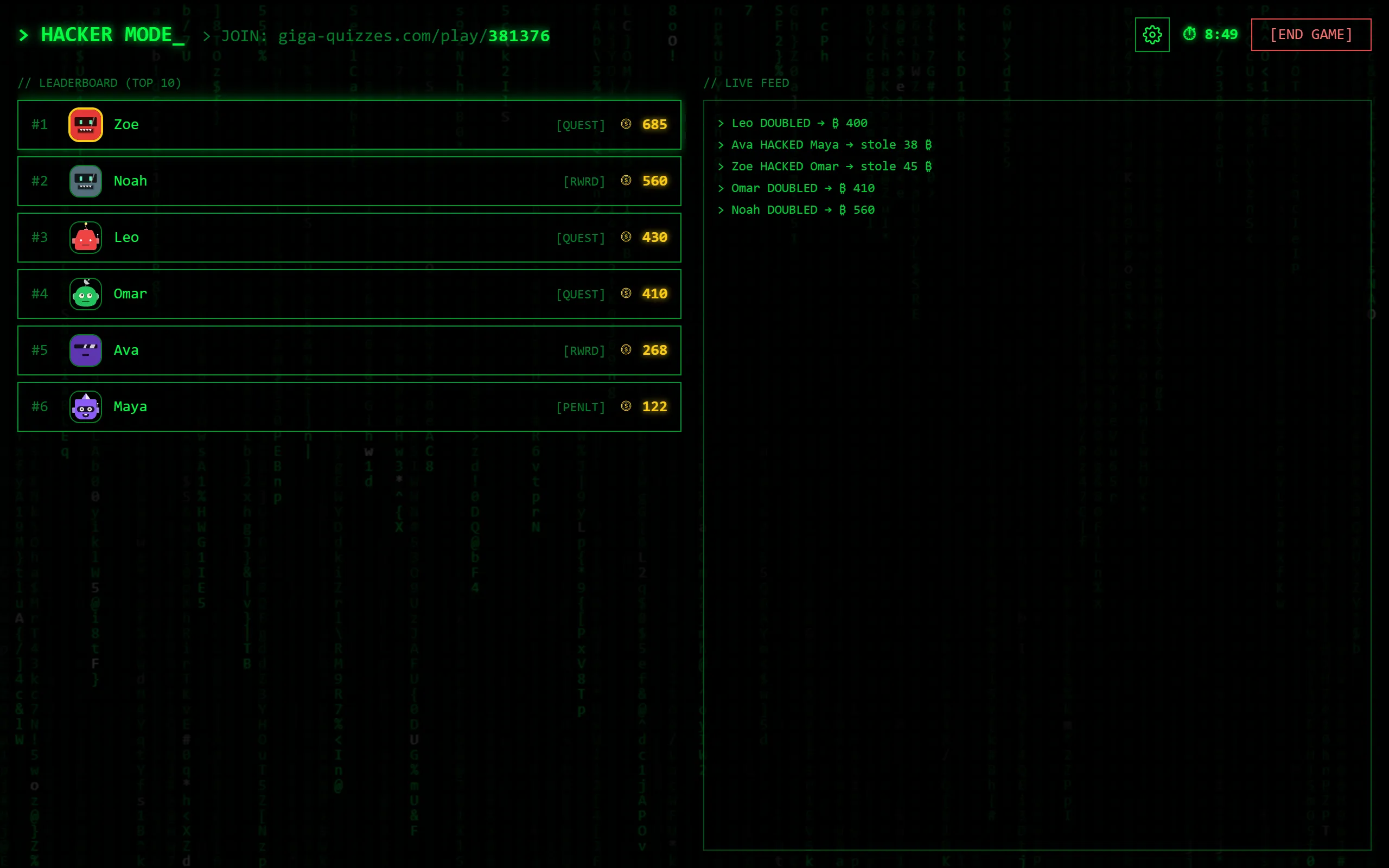
Hacker mode is built this way. Students answer at their own pace on their own phones, and every right answer opens one of three vaults. Most pay out crypto, some double or triple what a student has, and some let them hack a classmate by guessing their password and taking a share. A wrong answer costs three seconds and nothing more.
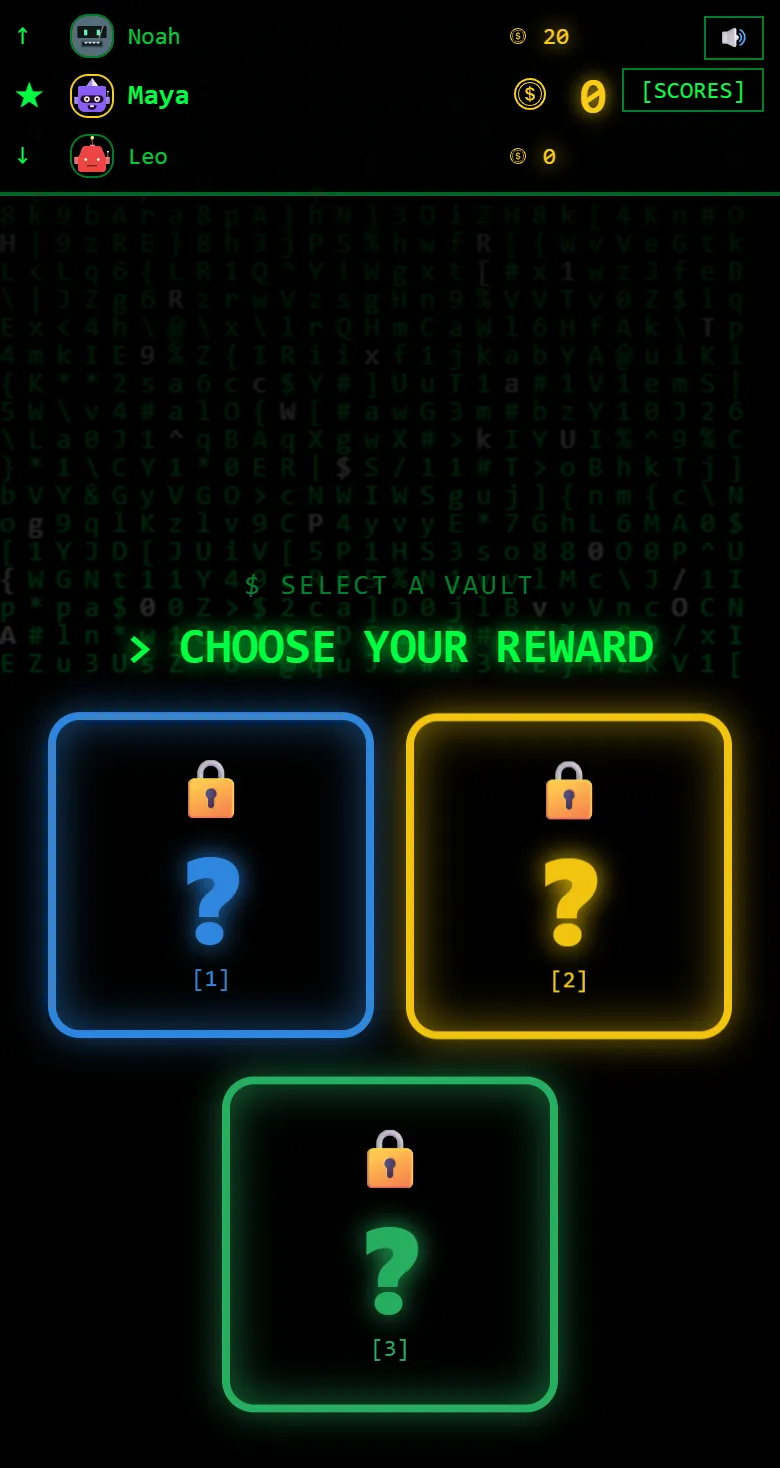
Because one lucky vault can lift a student from the bottom half to the top, nobody gives up, and the room stays loud until the clock runs out. Yet only a right answer opens a vault, so the students who know the most still get the most chances. Pirate Plunder works the same way with treasure chests instead of vaults, and the lead changes just as often.
A finish line a month away
One game is over in fifteen minutes. A race that runs for a month gives students a reason to try in every game, including the ones on topics they find hard.
If your class has a group in Giga Quizzes, every group game you host adds to its leaderboards. The Points leaderboard adds up each student’s scores from every classic group game, so it rewards turning up and trying each time rather than one good afternoon. Give the race an ending: after a month, or at the end of a unit, the student in first place wins a prize. Announce the date at the start, and remind the class as it gets close.
Prizes that cost little and mean a lot
- Choosing the topic of the next quiz
- First pick of seats for a week
- A certificate, or their name on the classroom wall
- Being the one who presses Start in the next game
- A small treat, if your school allows it
More than one way to win
Speed earns points in a live quiz. That is fun, but it favours quick readers and confident guessers. Some of your strongest students are careful rather than fast, and a points table alone tells them they are not winners.
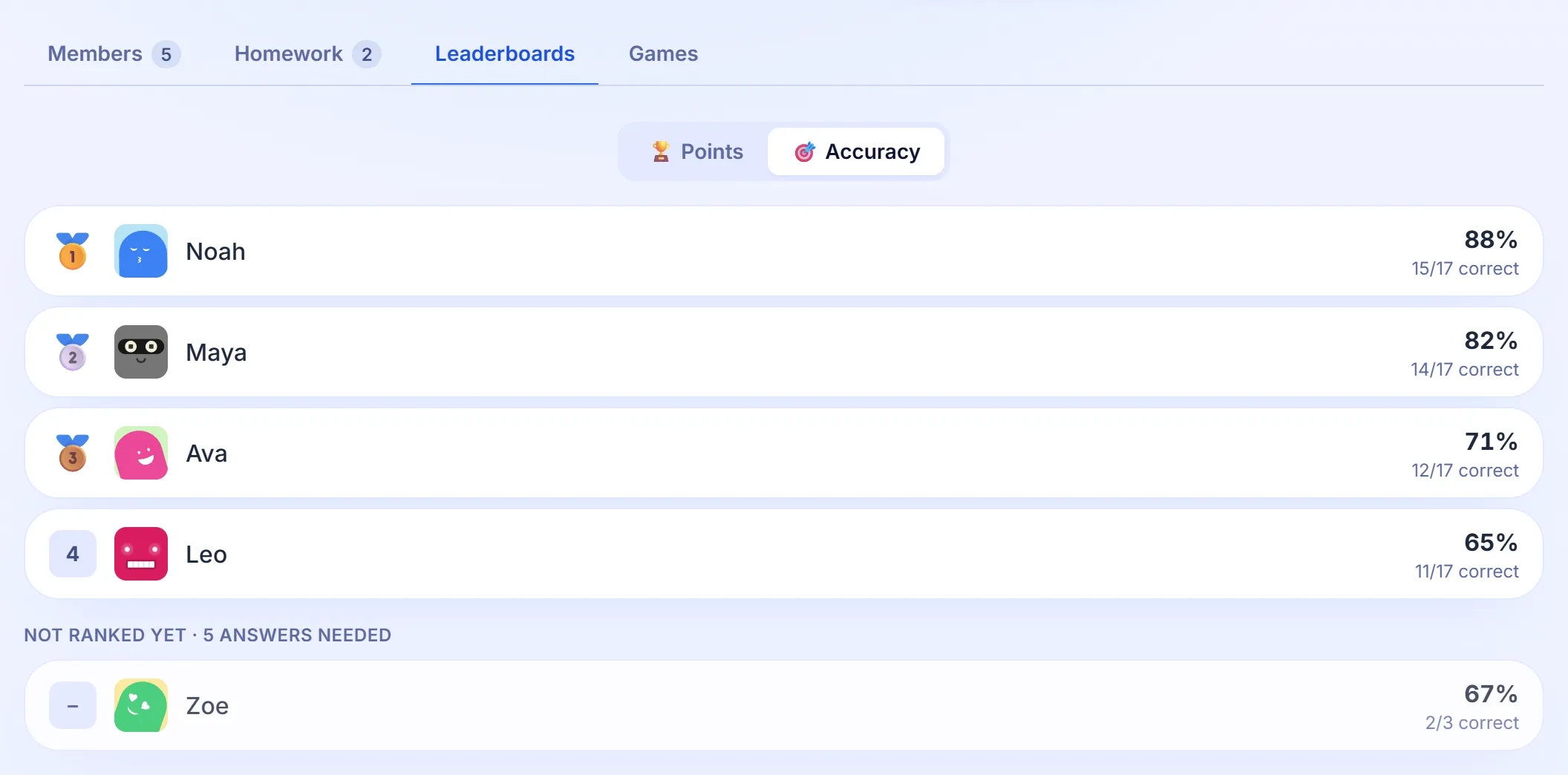
A group’s second leaderboard, Accuracy, ranks students by the share of questions they answered correctly. Nobody is ranked until they have answered at least five, so one lucky answer cannot put anyone on top. Announce both leaders at the end of the month and you have two kinds of champion: the fastest and the most careful.
Competition works better with teammates
Michael Sailer and Lisa Homner combined the results of dozens of studies on game elements in learning, known as gamification. They found small but real positive effects on what students learned, on their motivation and on their behaviour. One detail stands out for anyone running a class quiz: designs that combined competition with collaboration were particularly effective, at least for how much students took part and kept at it.
In practice that means teams. In a solo game, the student in last place matters to nobody. In a team game, every right answer they give adds to their team’s score, and their teammates notice. Playing in teams is one of the simplest ways to get quieter and weaker students trying harder, because the encouragement comes from the people sitting next to them rather than from you.
Let them see themselves improve
Competence is the need that quizzes serve best, and it does not depend on beating anyone. Run the same short quiz at the start and at the end of a topic, then show the class how many more answered each question correctly the second time. A question that most of the room missed two weeks ago, and nearly everyone gets right today, is a picture of progress that every student shares in.
What tends to backfire
- Showing the bottom of the table. Celebrate the top, the most improved and the most accurate. Nobody needs their last place on the projector.
- The same three winners every week. Switch formats, mix teams, and use the accuracy table so the podium changes.
- Questions that are too hard for most of the room. Repeated failure drains motivation faster than anything. A good quiz lets most students get most questions right.
- Games that run too long. Stop while the energy is high. A short game that ends on a laugh is remembered better than a long one that fizzles out.
Motivation in a quiz is not one trick. It is a race worth running, a finish line in sight, more than one way to win, a team to play for and a class that can see itself getting better.
Sources
- Ryan, R. M. & Deci, E. L. (2000). Self-determination theory and the facilitation of intrinsic motivation, social development, and well-being. American Psychologist, 55(1), 68–78.
- Sailer, M. & Homner, L. (2020). The gamification of learning: A meta-analysis. Educational Psychology Review, 32(1), 77–112.
Try it in Giga Quizzes
Free, in the browser, and nothing for your students to install. These guides show each step on the real screens.
New to Giga Quizzes?
Free live quizzes in the browser. Students join from any phone, with no app.
Make your first quiz →